Why Strategic Tax Planning Matters for Childcare Business Owners Year-Round

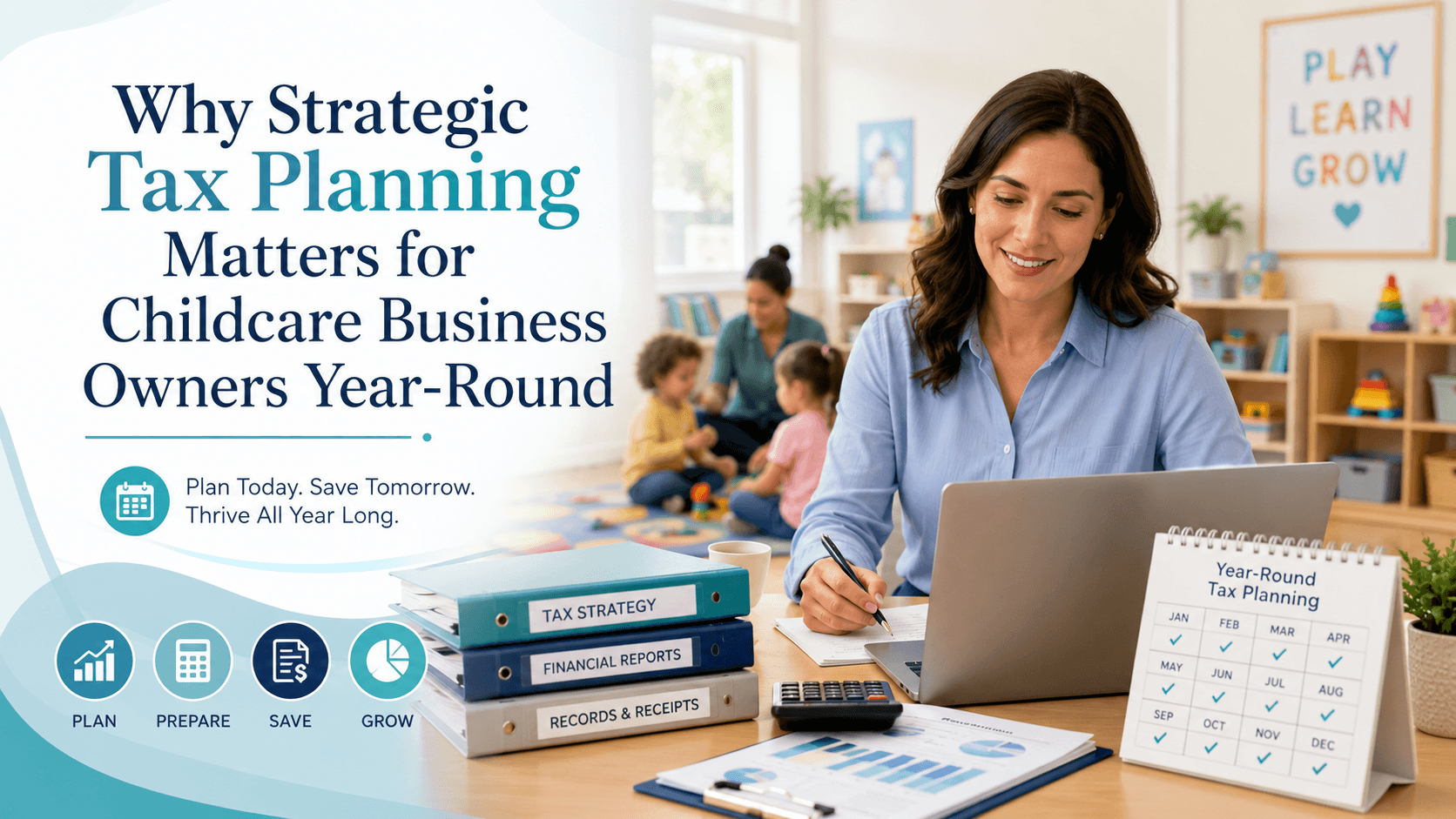
For many childcare business owners, taxes follow a familiar pattern.
The business runs all year. Tuition comes in. Payroll goes out. Supplies are purchased. Employees are hired. Equipment breaks. Enrollment changes. The owner takes money from the business when needed.
Then tax season arrives.
Only then does someone calculate what the business actually earned, how much tax is owed, and whether anything could have been done differently.
That is tax preparation.
Strategic tax planning is different.
Strategic tax planning looks at the daycare’s financial position throughout the year and asks a more useful question:
What decisions can we make now to improve the financial outcome later?
For childcare owners, that distinction matters because taxes are connected to nearly every major financial decision in the business—from payroll and owner compensation to equipment purchases, estimated payments, retirement contributions, expansion, and cash reserves.
A tax return tells you what happened.
A year-round tax strategy helps you decide what should happen next.
What Is Strategic Tax Planning?
Strategic tax planning is the ongoing process of reviewing a business’s income, expenses, structure, payroll, investments, deductions, credits, and future plans before important decisions and tax deadlines occur.
It is not simply searching for additional deductions in December.
A good tax strategy considers the entire financial picture.
For a childcare business, that may include:
- Current year-to-date profit
- Expected enrollment
- Tuition revenue
- Payroll
- Staffing changes
- Owner compensation
- Estimated tax payments
- Retirement contributions
- Equipment purchases
- Facility improvements
- Business debt
- Tax credits
- Home-daycare expenses
- Expansion plans
- Available cash
The purpose is not to reduce taxes at any cost.
The purpose is to manage taxes intelligently while supporting the financial health of the business.
Daycare AccountingPRO specifically positions its strategic tax-planning service around childcare owners, alongside bookkeeping and broader financial-management support.
Why Waiting Until Tax Season Is Often Too Late
Once the tax year has ended, many financial events cannot simply be rewritten.
You generally cannot go back and change:
- Payroll that was already processed
- Owner distributions that were already taken
- Business purchases that were never made
- Retirement-plan actions with earlier deadlines
- Equipment that was not placed in service
- Business decisions made without tax planning
- Missing records that were never properly maintained
- Cash that has already been spent
Your tax professional can still prepare an accurate return and identify deductions supported by the records.
But the opportunity to make certain strategic decisions may already be gone.
That is why tax planning works best as a recurring business process rather than a once-a-year conversation.
Strategic Tax Planning Starts With Accurate Bookkeeping
You cannot plan effectively from numbers you do not trust.
If a daycare’s books are several months behind, the tax professional may not know:
- Current profit
- Actual payroll costs
- Total owner distributions
- Whether all income has been recorded
- Whether expenses are categorized correctly
- How much debt the business carries
- Whether payroll liabilities remain unpaid
- How much cash is genuinely available
The IRS notes that good records help business owners monitor business progress, prepare financial statements, identify income, track deductible expenses, prepare tax returns, and support amounts reported on those returns.
That means bookkeeping is not simply an administrative requirement.
It is the financial foundation of strategic tax planning.
A daycare owner should know these numbers regularly
At minimum:
- Year-to-date revenue
- Year-to-date operating expenses
- Payroll expense
- Net operating profit
- Cash on hand
- Outstanding debt
- Accounts receivable
- Tax reserve
- Owner draws or distributions
- Estimated taxes already paid
Without those numbers, tax planning becomes guesswork.
1. Year-Round Planning Helps Prevent Tax Surprises
One of the most common problems for business owners is discovering a large tax liability after most of the business cash has already been spent.
Imagine a daycare owner sees $70,000 in the business bank account near the end of the year.
The owner assumes the business has done well and takes a $30,000 distribution.
Later, the tax projection shows that the daycare generated considerably more taxable income than expected. Payroll and operating expenses still need to be paid, and a substantial amount of the remaining cash is needed for taxes.
The business suddenly feels cash-poor even though it was profitable.
The underlying problem was not necessarily the amount of tax.
The problem was that the tax liability was not incorporated into the daycare’s cash-management decisions throughout the year.
A better approach
Review projected tax liability regularly.
Then maintain a tax reserve based on the business’s actual circumstances.
This gives the owner a clearer answer to an important question:
How much of the cash in the bank is truly available to spend?
2. Estimated Tax Payments Should Reflect the Current Year
Business income does not always have taxes withheld automatically.
Individuals including sole proprietors, partners, and S corporation shareholders generally use Form 1040-ES to calculate estimated tax when applicable. The calculation considers expected adjusted gross income, taxable income, taxes, deductions, and credits for the current year.
Estimated tax may cover income tax as well as other taxes, including self-employment tax when applicable.
The problem is that many owners base their payments entirely on last year.
But childcare businesses can change quickly.
Suppose this year you:
- Added 25 new enrollments
- Raised tuition
- Opened another classroom
- Hired several employees
- Lost a major subsidy contract
- Purchased equipment
- Increased owner compensation
- Received a grant
- Opened another location
- Had significant facility repairs
Last year’s profit may no longer provide a useful estimate.
Strategic planning allows recalculation
Instead of waiting until tax filing, your tax professional can periodically review:
- Current profit
- Expected remaining revenue
- Expected expenses
- Other household income
- Owner compensation
- Previous estimated payments
- Withholding
- Potential deductions
- Potential credits
The tax projection can then be updated as the business changes.
3. Tax Planning Helps Owners Understand the Difference Between Profit and Cash
This is one of the most important financial concepts for a childcare owner.
Profit is not the same as cash.
A daycare can make a profit while having little cash available.
It can also have significant cash in the bank without having earned all of that cash as taxable business profit.
For example, cash may enter the business through:
- Tuition
- Registration fees
- Subsidies
- Loans
- Owner contributions
- Grants
- Advance payments
Not every deposit receives identical accounting or tax treatment.
Cash may leave the business through:
- Payroll
- Operating expenses
- Loan principal
- Equipment purchases
- Owner distributions
- Tax payments
Not every withdrawal reduces taxable profit in the same way.
If tax planning is performed using only the bank balance, the result can be misleading.
That is why strategic planning should use the daycare’s bookkeeping reports—not just online banking.
4. Better Tax Planning Improves Owner Compensation Decisions
How a childcare business owner takes money from the business depends partly on the entity structure.
Depending on the business, payments may include:
- Owner draws
- Partner distributions
- Guaranteed payments
- W-2 compensation
- Shareholder distributions
- Expense reimbursements
- Loan repayments
These should not be treated interchangeably.
For example, moving $10,000 from a business account to a personal account does not automatically make it a deductible expense.
Strategic tax planning allows the owner and professional to review compensation before year-end rather than discovering after the fact that payments were handled incorrectly.
Questions worth reviewing include:
- How much has the owner taken from the company?
- How much has been processed through payroll?
- Has the owner personally paid business expenses?
- Has the business paid personal expenses?
- Are there loans between the owner and business?
- How much cash can safely be distributed?
- Does the existing entity structure still make sense?
Owner compensation should be part of an organized strategy, not a series of random transfers based on personal cash needs.
5. Tax Planning Helps Daycare Owners Make Better Hiring Decisions
Hiring another employee affects much more than the employee’s hourly wage.
A daycare may also incur:
- Employer payroll taxes
- Workers’ compensation
- Training
- Background checks
- Benefits
- Payroll processing fees
- Paid time off
- Overtime exposure
- Retirement-plan obligations
For childcare centers, staffing is especially important because staffing levels are connected to enrollment capacity, classroom ratios, and service quality.
Before adding another position, strategic financial planning can estimate:
How much additional revenue does this employee need to support?
If the employee allows the center to open additional enrollment spots, the hire could increase profitability.
If the classroom is already under-enrolled, adding another employee may reduce profit.
Because payroll affects taxable business income and cash flow, major hiring decisions belong in the broader tax and financial plan.
6. Strategic Planning Can Improve Equipment Purchase Decisions
Daycares regularly need:
- Classroom furniture
- Cribs
- Cots
- Kitchen equipment
- Computers
- Security cameras
- Playground equipment
- Flooring
- HVAC equipment
- Appliances
- Vehicles
A common mistake is assuming that buying equipment automatically creates an immediate tax deduction.
The actual treatment depends on the type of property, applicable depreciation rules, available elections, business use, and when the property is placed in service.
The IRS provides specific depreciation and expensing rules for business property, including Section 179 rules and other depreciation provisions.
Strategic planning changes the conversation
Instead of asking:
“What can I buy to reduce my taxes?”
Ask:
“What does the daycare actually need, and what is the most financially efficient way to acquire it?”
The tax professional can then evaluate the tax consequences of:
- Buying now
- Buying next year
- Financing
- Paying cash
- Repairing existing equipment
- Replacing equipment
- Making a facility improvement
A tax deduction should support a good business decision—not create a bad one.
7. Year-Round Planning Helps Protect Legitimate Deductions
A valuable business expense can be lost or questioned when the supporting records are poor.
That is especially relevant in childcare businesses because owners and employees frequently purchase small items from:
- Grocery stores
- Warehouse stores
- Online retailers
- Office-supply stores
- Home-improvement stores
- Educational retailers
These purchases may include both personal and business items.
Good recordkeeping should show business income, deductions, and credits clearly. The IRS also states that businesses may use a recordkeeping system appropriate to their operation as long as it clearly shows income and expenses.
Instead of recording:
Amazon — $728
The books should ideally provide enough documentation to determine whether the transaction included:
- Classroom supplies
- Toys
- Cleaning materials
- Office equipment
- Personal purchases
- Capital equipment
The better the bookkeeping, the easier it is for the tax professional to evaluate legitimate deductions.
8. Home-Based Family Daycares Benefit From Ongoing Recordkeeping
Family daycare providers face financial issues that differ from center-based businesses.
Their tax records may involve:
- Business use of the home
- Household utilities
- Daycare-use areas
- Operating hours
- Meal costs
- Home repairs
- Insurance
- Vehicle use
- Supplies purchased personally
The difficulty is that many of these records are much easier to maintain during the year than reconstruct months later.
If a provider waits until tax season to remember:
- How many hours the daycare operated
- How frequently rooms were used
- Which repairs related to daycare
- Which grocery purchases were business-related
- How many business miles were driven
the resulting information may be incomplete.
Strategic tax planning therefore includes recordkeeping systems—not merely calculations.
9. Retirement Planning Can Be Part of the Tax Strategy
A successful childcare owner should not think only about this year’s tax bill.
Long-term personal financial planning also matters.
Small business owners may have access to several retirement-plan structures depending on their business and employees. The IRS maintains resources covering retirement options for small employers and self-employed individuals.
Potential options may include:
- SEP arrangements
- SIMPLE IRA plans
- 401(k) plans
- One-participant 401(k) plans in qualifying owner-only businesses
- Other qualified plans
A one-participant 401(k), for example, is generally designed for a business owner with no employees other than potentially the owner’s spouse.
However, choosing a plan involves more than finding the highest possible contribution amount.
The owner should consider:
- Employees
- Eligibility requirements
- Employer contributions
- Payroll
- Administrative costs
- Cash flow
- Retirement goals
- Establishment deadlines
- Contribution deadlines
The best time to discuss these questions is before deadlines become the deciding factor.
10. Tax Planning Should Be Connected to Enrollment and Tuition
This is where tax planning becomes business planning.
Suppose tuition increases by 7%.
That may increase annual revenue significantly.
But what if:
- Payroll increases 10%?
- Food costs increase?
- Insurance renews at a higher rate?
- The daycare adds administrative staff?
- A classroom remains partially empty?
The tax projection may show more taxable income, while financial analysis may show that margins are still getting weaker.
Strategic tax planning helps owners connect business growth with what they actually retain.
Instead of measuring success only by total revenue, childcare owners should ask:
- What is our net profit?
- What percentage of revenue goes to payroll?
- Which classrooms generate adequate margins?
- Which programs are underperforming?
- How much cash is left after taxes?
- Are tuition rates keeping pace with costs?
More revenue is useful only when the business also controls costs and produces sustainable profit.
11. Tax Planning Helps Prepare for Expansion
Opening a second daycare location can involve:
- Lease deposits
- Build-out costs
- Licensing
- Furniture
- Playground equipment
- Marketing
- Technology
- Additional payroll
- Insurance
- Professional fees
- Financing
These decisions may cross tax years and involve different accounting treatments.
Waiting until after the project is complete to discuss taxes can limit the planning options.
Before expansion, review:
- Projected opening date
- Startup costs
- Financing
- Equipment purchases
- Leasehold improvements
- Expected enrollment
- Payroll before break-even
- Cash reserve
- Entity structure
- Tax consequences
The question should not only be:
“Can we afford to open another location?”
It should also be:
“How does this expansion affect cash flow, taxable income, financing, and owner compensation over the next 12 to 24 months?”
12. Tax Credits Should Be Reviewed Before Opportunities Pass
Tax credits can change, expire, or have specific eligibility requirements.
A childcare business may encounter possible federal or state incentives connected to:
- Employees
- Retirement plans
- Health coverage
- Energy investments
- Facility improvements
- Employer-provided childcare
- Hiring
Whether any particular credit applies depends on the facts and the law in effect for that year.
That is another reason tax strategy should be proactive.
A project should be reviewed before it begins when possible, not only after invoices arrive.
13. Strategic Planning Can Prevent Unnecessary Debt
Taxes become dangerous when owners do not reserve cash.
Consider this sequence:
- The daycare has a profitable year.
- The owner sees excess cash.
- The cash is distributed or spent.
- Tax season arrives.
- A large balance is due.
- The business uses a credit card or loan to pay taxes.
The daycare has now converted a predictable tax obligation into debt.
A year-round tax reserve can reduce this risk.
A simple system
After each tax projection:
- Determine the expected obligation.
- Subtract payments already made.
- Compare the remaining amount with the tax reserve.
- Transfer additional cash when necessary.
- Keep the reserve separate from operating cash.
This process also gives the owner greater confidence when making distributions.
14. Year-Round Tax Planning Creates Better Year-End Planning
Year-end planning works much better when the first financial review does not occur in December.
Imagine two daycare owners.
Owner A
The books are current through November.
Payroll is reconciled.
Estimated payments have been reviewed quarterly.
The tax professional knows about upcoming equipment purchases.
Retirement planning began months ago.
Owner distributions are documented.
When the year-end meeting occurs, the owner can focus on final decisions.
Owner B
The books are current only through June.
Receipts are missing.
Payroll does not match the accounting records.
No tax reserve exists.
Several personal purchases are mixed into business expenses.
The owner cannot remember how much money was withdrawn.
The December tax-planning meeting becomes a bookkeeping cleanup project.
The second owner technically scheduled a year-end tax meeting.
The first owner practiced year-round tax planning.
That difference matters.
A Practical Quarterly Tax Planning Schedule for Childcare Owners
Tax planning does not require constant meetings.
A structured schedule can keep the process manageable.
January through March
Review:
- Prior-year results
- Final bookkeeping adjustments
- Current tuition rates
- Payroll budget
- Business goals
- Expected annual profit
- Owner compensation
- Current entity structure
- Retirement strategy
Use the prior year’s results to establish a financial baseline.
April through June
Review:
- First-quarter profit
- Enrollment
- Payroll
- Estimated taxes
- Owner distributions
- Large planned purchases
- Cash reserves
Compare actual results with the beginning-of-year plan.
July through September
Review:
- Midyear profitability
- Staffing changes
- Tuition adjustments
- Expansion plans
- Equipment needs
- Retirement plans
- Tax projections
- Year-to-date estimated payments
By this point, the current year’s financial picture is usually much clearer.
October through December
Review:
- Full-year projected profit
- Final estimated tax strategy
- Owner compensation
- Equipment purchases
- Facility improvements
- Retirement contributions
- Tax credits
- Contractor records
- Payroll
- Year-end distributions
- Cash needed for January
This makes year-end planning the final stage of an ongoing process rather than an emergency.
Questions Every Childcare Owner Should Ask During a Tax Planning Meeting
A productive tax-planning meeting should produce actionable answers.
Ask:
About taxes
- What is our projected taxable income?
- What is our estimated federal tax obligation?
- What state or local tax should we expect?
- Are our estimated payments on track?
- How much should remain in the tax reserve?
About deductions
- Are expenses being categorized properly?
- Are we missing commonly overlooked business costs?
- Are large purchases being treated correctly?
- What documentation needs improvement?
About the business
- How has profit changed from last year?
- Is payroll growing faster than revenue?
- Do we have adequate cash reserves?
- Can we afford planned expansion?
- How much can the owner safely withdraw?
About upcoming decisions
- Should equipment be purchased now or later?
- Are retirement-plan decisions approaching?
- Are there potentially relevant tax credits?
- Does the current business structure still make sense?
Those questions turn tax planning into a management tool.
Signs Your Daycare Needs More Proactive Tax Planning
You may need a stronger year-round strategy if:
- You regularly owe much more tax than expected.
- Your bookkeeping is several months behind.
- You do not know the daycare’s current profit.
- Estimated tax payments are based only on last year.
- You use operating cash to pay unexpected tax bills.
- Large purchases happen without consulting your accountant.
- Owner distributions are made based on the bank balance.
- Payroll reports do not regularly match the books.
- Your accountant hears about major business decisions after they happen.
- You only discuss tax strategy during tax season.
- You are growing but still feel short on cash.
- You are unsure whether your business structure is still appropriate.
These are not simply tax problems.
They are signs that taxes and financial management are not yet operating as one coordinated system.
Tax Planning Should Support Profitability—not Just Lower the Tax Bill
A tax strategy that saves $5,000 but causes the business to spend $20,000 unnecessarily is not automatically a good strategy.
Likewise, avoiding a profitable opportunity solely because it increases taxes may leave the business worse off.
Consider two scenarios.
Scenario A
A daycare earns an additional $100,000 in revenue and generates $25,000 of additional profit.
Taxes increase because the business made more money.
That is not necessarily a bad result.
Scenario B
The daycare purchases $25,000 of equipment it does not need simply because the owner wants another deduction.
Taxes may decrease, but the business also gave up cash.
The correct objective is not:
Pay the smallest amount of tax possible regardless of the consequences.
It is:
Structure the business intelligently, claim appropriate deductions and credits, plan liabilities in advance, and retain as much healthy after-tax profit as possible.
Strategic Tax Planning and Bookkeeping Should Work Together
Year-round tax planning becomes much more effective when the bookkeeper and tax professional work from the same reliable financial information.
Monthly bookkeeping tells you:
Where are we now?
Tax planning asks:
Where are we going if nothing changes?
Strategic financial management asks:
What should we change?
Together, those questions help childcare owners make better decisions.
Daycare AccountingPRO combines childcare-specific bookkeeping with strategic tax planning and financial-management support designed around the operational realities of childcare businesses.
Build Tax Planning Into the Way You Run Your Daycare
The most effective tax strategy is rarely created during one meeting.
It develops throughout the year as the childcare business changes.
Enrollment changes.
Payroll changes.
Expenses change.
Tax laws change.
The owner’s goals change.
A strategy created in January may need to be adjusted in June and reviewed again before year-end.
That is why strategic tax planning should become part of the daycare’s regular financial rhythm.
Keep the books current.
Review profit regularly.
Project taxes.
Maintain a tax reserve.
Discuss major decisions before making them.
Review owner compensation.
Plan significant purchases.
Consider long-term retirement and business goals.
Then, when tax season arrives, the primary question should not be:
“How much do I owe, and why is it so much?”
Instead, the owner should already understand the financial picture and have the cash and records prepared.
Daycare AccountingPRO helps childcare business owners connect bookkeeping, tax planning, and financial strategy throughout the year—not simply when a return is due.
Schedule a strategic tax-planning consultation with Daycare AccountingPRO to review your daycare’s current financial position, projected tax liability, cash flow, owner compensation, and opportunities for the months ahead.
This article is for general educational purposes and is not individualized tax, accounting, legal, or financial advice. Tax rules, limits, deadlines, and available strategies can change. Consult qualified professionals regarding your specific business and tax situation.