Tax Planning for Childcare: A Practical Guide to Paying Less (Legally) and Keeping More Cash in Your Center


Tax planning for childcare isn’t about “doing taxes” once a year. It’s about making smart, legal moves before the year ends so your daycare or childcare center keeps more money — and avoids ugly surprises at tax time.
If you run an in-home program, a single center, or multiple locations, the basics are the same: you want clean numbers, the right structure, the right categories, and a plan that matches how childcare income really works (tuition timing, subsidies, CACFP, staffing ratios, and seasonal enrollment shifts).
What “tax planning for childcare” actually means
Tax planning is the process of:
- Estimating what you’re likely to owe ahead of time
- Adjusting how income is recorded and timed (when possible)
- Capturing every legitimate childcare-specific deduction
- Setting up payroll and owner pay correctly
- Choosing the best business structure for your income level
- Avoiding penalties from underpaying quarterly taxes
It’s proactive. The goal is simple: reduce your tax liability legally and improve cash flow, not just file a return.
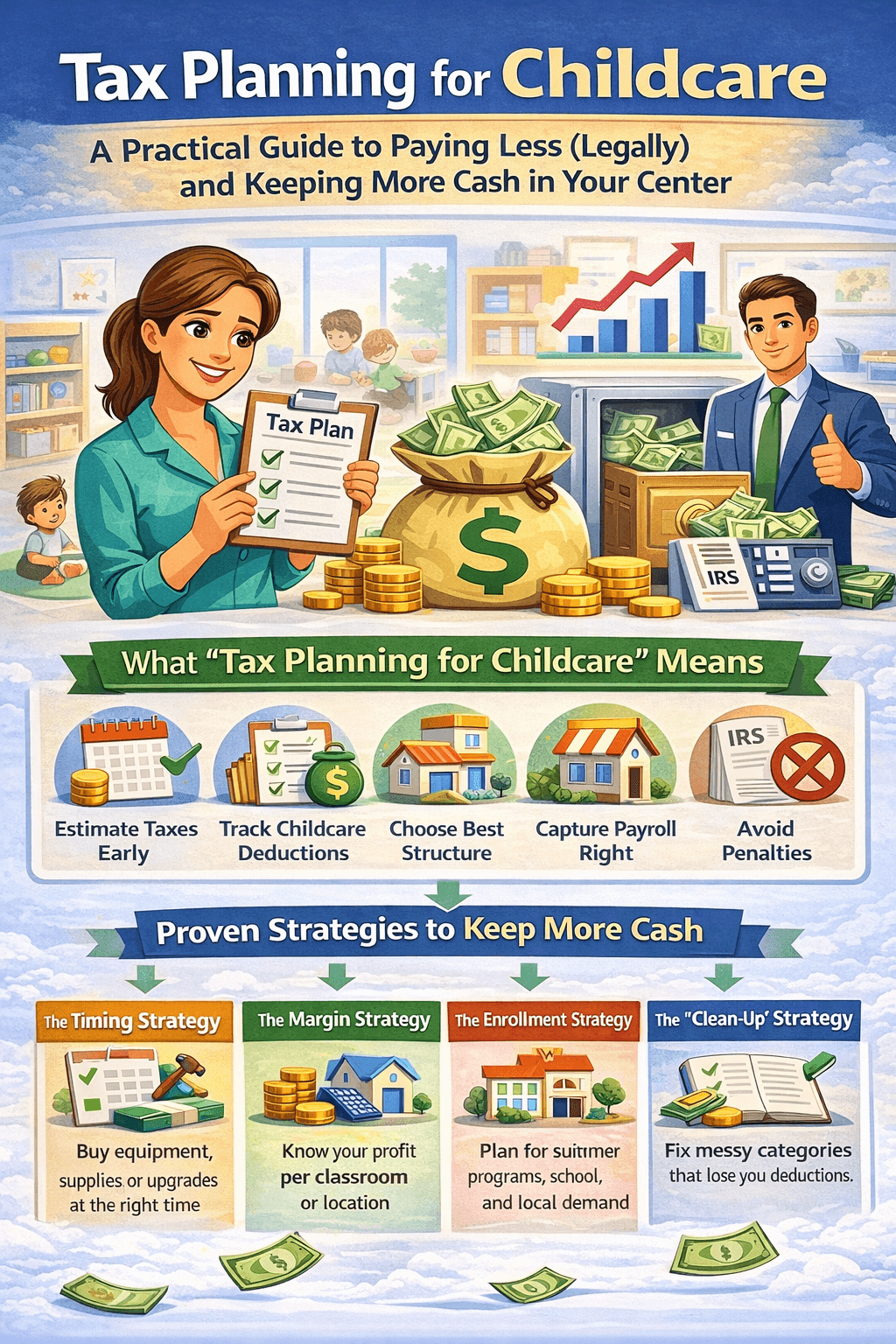
Tax Planning for Childcare
Why childcare businesses overpay more than most industries
Childcare is unique. Many owners overpay because their books don’t reflect how childcare operates, like:
- Mixed revenue types (private pay, subsidy reimbursements, grants)
- CACFP reimbursements and food costs
- High payroll and contractor confusion
- Tuition timing (weekly/monthly, prepaid, deposits, enrollment changes)
- Licensing, training, background checks, and compliance costs
- Facility and classroom supplies that aren’t categorized correctly
When categories are messy, deductions get missed. When projections aren’t done, owners pay whatever the tax bill says — and hope it’s “normal.”
The #1 tax planning mistake: waiting until you “have time”
Most tax savings opportunities disappear after December 31.
By the time you’re handing a pile of statements to a preparer in March or April, the best levers are already gone — and the outcome is mostly locked in.
Tax planning works best when it happens:
- Mid-year (to correct course)
- In Q4 (to finalize year-end moves)
- Before big decisions (hiring, expansion, buying equipment, opening a second location)
Childcare tax planning checklist: start here
If you want a simple starting point, use this checklist.
1) Make sure your bookkeeping is tax-ready (not just “done”)
Tax planning relies on accurate numbers. That means:
- Monthly reconciliations (bank + credit card)
- Clear income separation (tuition vs subsidy vs other)
- Payroll properly classified
- A chart of accounts that fits childcare
If your books are behind or inconsistent, you can still plan — but the first step is getting a reliable baseline.
2) Track childcare-specific deductions the right way
Some common areas where childcare businesses leave money on the table:
- Meals and food program costs (CACFP-related)
- Curriculum, toys, classroom materials, and learning supplies
- Licensing fees, inspections, compliance expenses
- Background checks, CPR/first-aid training, required certifications
- Staff recruiting, training, and retention costs
- Facility costs (rent, utilities, repairs, cleaning, security systems)
- Software and admin systems (childcare management software, accounting tools)
- Insurance (general liability, workers comp, business insurance policies)
- Marketing (local ads, website, signage, promotions)
The key isn’t just “having expenses.” It’s making sure they’re coded helpfully and consistently so they don’t get buried in vague buckets like “misc.”
3) Get quarterly estimated taxes under control
Many childcare owners get hit with penalties because they underpay estimated taxes (or don’t pay them at all).
Tax planning helps you:
- Estimate the year’s profit early
- Set a quarterly payment schedule
- Adjust payments when enrollment or payroll changes
Even one strong quarterly projection can prevent a painful year-end bill.
4) Choose the right business structure for your income level
This is one of the biggest tax levers — but it has to match your situation.
For some childcare owners, a basic setup is fine. For others (especially higher-profit centers), structure choices can change:
- How owner income is taxed
- Whether payroll strategies make sense
- How benefits and reimbursements are handled
This is an area where you want a professional to run the numbers — because the “best” setup depends on profit, payroll, and growth plans.
5) Fix owner pay and payroll strategy
Payroll is usually the biggest expense in childcare — and also one of the biggest sources of tax mistakes.
Tax planning reviews things like:
- Are you running payroll correctly?
- Are staff properly classified?
- Are payroll taxes being handled consistently?
- Are reimbursements and owner compensation set up correctly?
Getting payroll right protects you and strengthens your deductions.
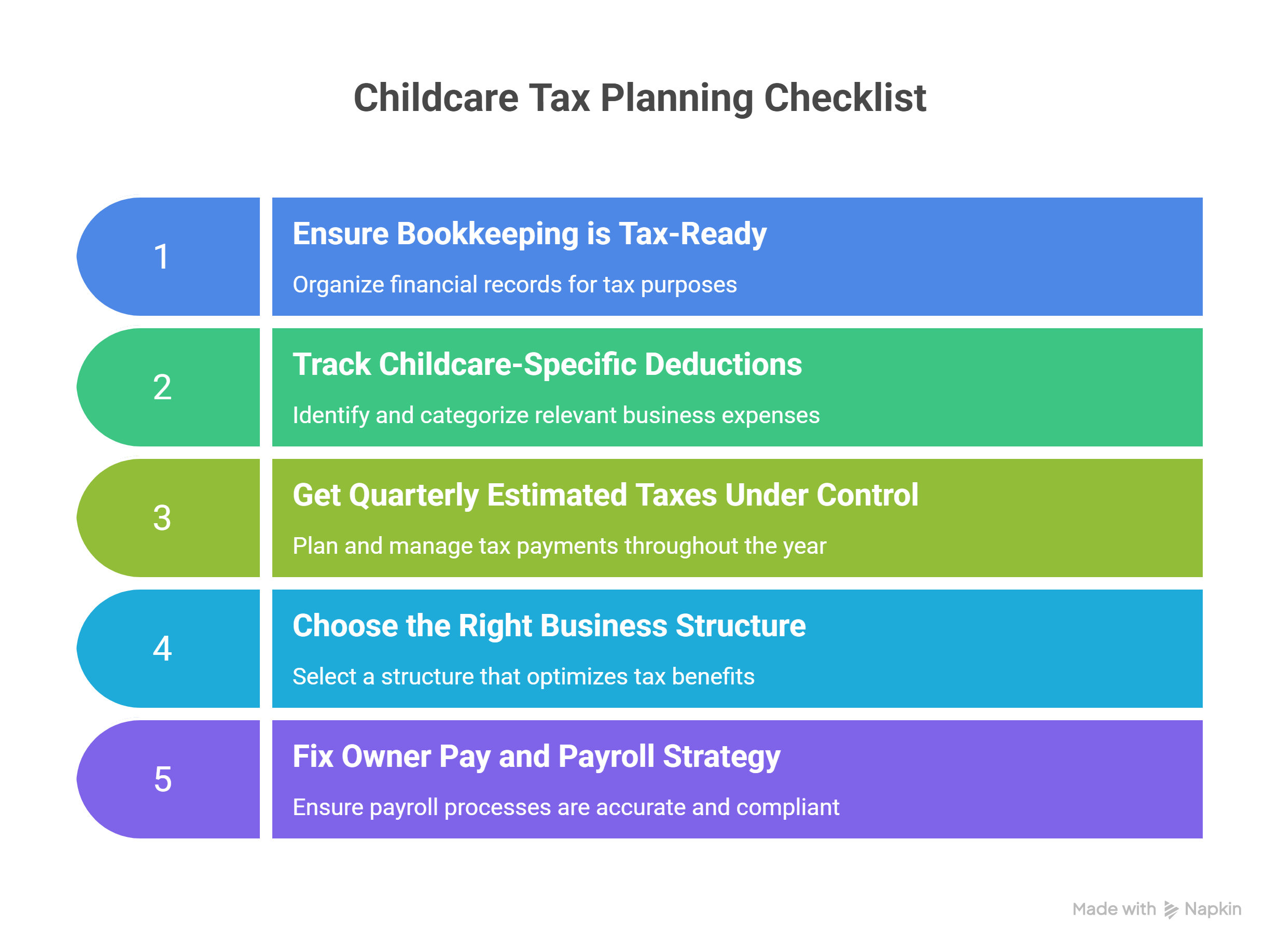
Childcare tax planning checklist
Tax planning strategies that often work well for childcare owners
These strategies are common in childcare — but the right move depends on your profit level and business setup.
Timing strategy: plan purchases and improvements intentionally
If you’re planning to buy equipment, improve the facility, or upgrade systems, the timing can matter for taxes. Planning ahead helps you decide:
- What to buy
- When to buy it
- How it should be categorized
- How it affects cash flow and taxable income
Margin strategy: understand your true profit per classroom (or per site)
Many owners only look at bank balance. Tax planning looks at profit per:
- Classroom
- Age group
- Location
- Program type (full-time, part-time, after-school)
Once you know what actually produces profit, you can make better decisions about staffing, pricing, and expansion — and your tax plan becomes more predictable.
Enrollment strategy: plan around seasonality
Childcare revenue often changes with:
- Summer schedules
- School-year routines
- Local demand
- Staffing availability
A tax plan that ignores seasonality causes estimated tax problems and cash stress. A good plan accounts for it.
“Clean-up” strategy: stop losing deductions to messy categories
Two childcare centers can have the same expenses — and wildly different tax outcomes — simply because of how the books are categorized.
A tax planning review often finds:
- Missing categories
- Duplicate categories
- Personal expenses mixed into business (or vice versa)
- Income that isn’t separated correctly
Fixing those issues can immediately improve deductions and reporting.
Tax planning for multi-center and high-revenue childcare businesses
If you’re running a 7-figure childcare operation or managing multiple locations, tax planning becomes less about “basic deductions” and more about:
- Scalable reporting by location
- Payroll optimization at scale
- Cash flow forecasting
- Expansion planning (leases, buildouts, hiring ramp)
- A reliable monthly dashboard for decision-making
At this level, the cost of “winging it” grows fast. A small planning mistake can turn into a huge tax bill.
Common questions about tax planning for childcare
How often should childcare owners do tax planning?
At minimum: once per quarter (aligned with estimated taxes).
Many established centers benefit from monthly review plus quarterly planning.
Is tax planning different from tax preparation?
Yes. Tax preparation reports what happened.
Tax planning helps shape what happens so the outcome is better.
What if my bookkeeping is behind?
You can still plan — but the first step is catching up enough to get reliable numbers. Without accurate income and expenses, planning becomes guesswork.
Do in-home daycares need tax planning too?
Absolutely. In-home programs often miss deductions or struggle with clean separation of business vs personal spending. Tax planning helps clarify both.
A simple next step: get a childcare tax plan built around your numbers
If you’re serious about lowering what you pay (legally), the next step is to get a real plan — not generic advice.
A proper childcare tax plan typically includes:
- A review of your last 1–2 years (to spot missed opportunities)
- A projection of your current-year tax liability
- A strategy built around your enrollment, payroll, and expenses
- A clear action list for the next 30–90 days
Book a Childcare Tax Planning Assessment
If you want to know whether you’re overpaying and what you can do about it, schedule a Tax Planning Assessment with Daycare AccountingPRO. We’ll review your situation, identify high-impact savings opportunities, and map out the next steps so you can keep more of what your center earns.
(This article is for educational purposes and isn’t individualized tax advice. Your best strategy depends on your numbers and business setup.)