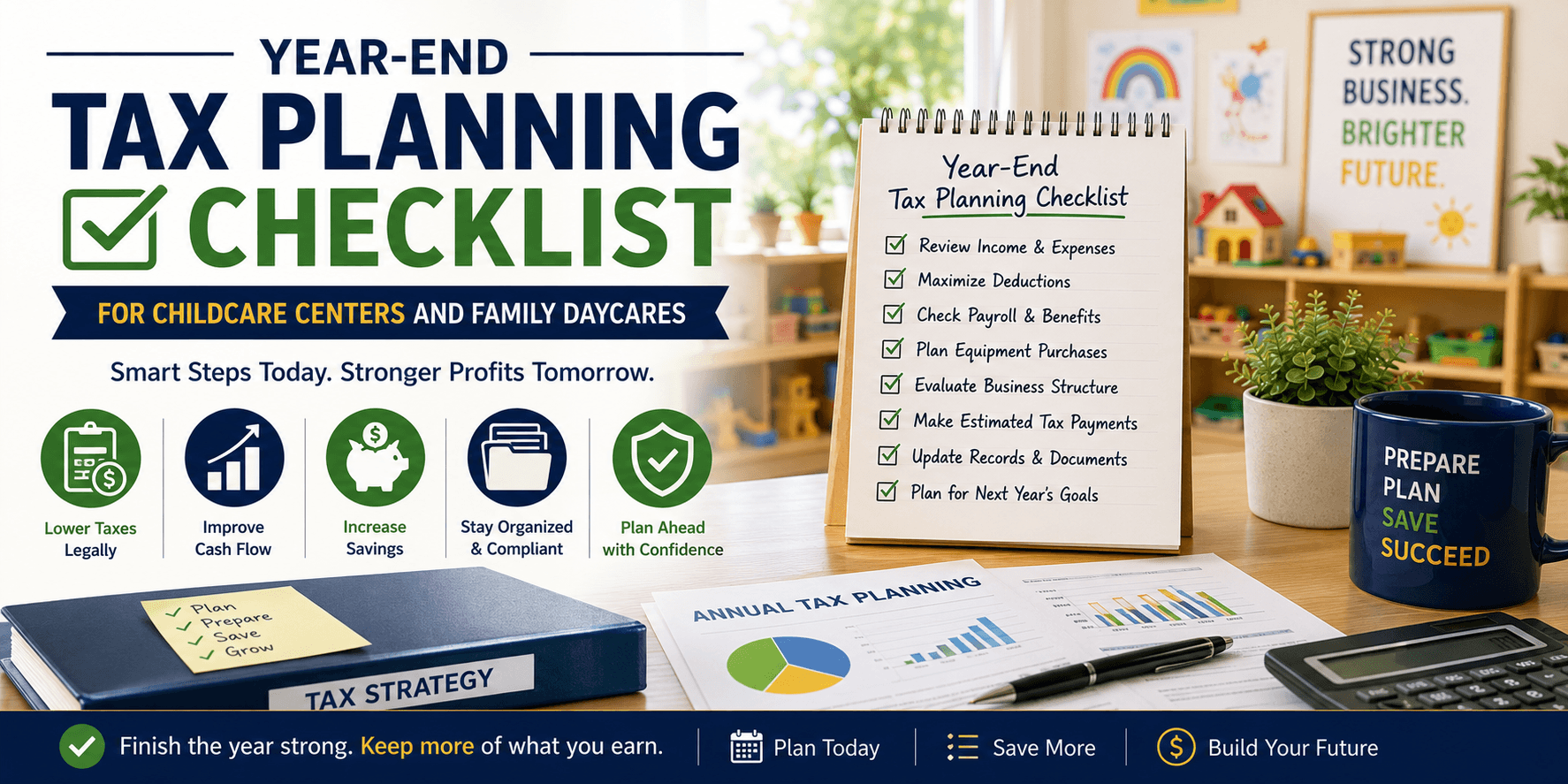
Year-End Tax Planning Checklist for Childcare Centers and Family Daycares

The final months of the year can be demanding for childcare business owners.
Teachers request time off. Holiday schedules affect attendance. Families may fall behind on tuition. Enrollment for the coming year needs attention. Payroll continues whether classrooms are full or not, and owners are often balancing business responsibilities with their own family commitments.
Tax planning can easily become something to handle later.
The problem is that many useful tax decisions must be reviewed before the year ends. Once December 31 passes, some opportunities may become limited or disappear completely.
A strong year-end tax plan is not simply a list of receipts to send to a tax preparer. It is a coordinated review of the daycare’s books, payroll, business structure, deductions, equipment purchases, employee benefits, tax payments, and plans for the next year.
This year-end tax planning checklist for childcare centers and family daycares will help you identify what should be reviewed, why it matters, and which records your bookkeeping and tax professionals will need.
Why Year-End Tax Planning Should Begin Before Tax Season
Tax preparation and tax planning serve different purposes.
Tax preparation reports financial activity after the year has ended. Tax planning examines the business before year-end and asks whether there are legitimate decisions the owner can still make.
For example, year-end tax planning may help a daycare owner determine whether to:
- Adjust an estimated tax payment
- Make a planned equipment purchase
- Establish or contribute to a retirement plan
- Issue an employee bonus
- Correct payroll discrepancies
- Document home-daycare operating hours
- Collect missing contractor information
- Review owner compensation
- Delay a nonessential distribution
- Build a larger tax reserve
- Complete an eligible business project before year-end
The best tax-planning meeting is not one where the owner simply learns how much tax is due. It is one where the owner still has enough time and accurate information to make thoughtful decisions.
1. Bring the Daycare’s Bookkeeping Up to Date
Year-end tax planning cannot begin with incomplete books.
Before reviewing deductions or tax strategies, every major financial account should be reconciled through the most recent available month.
This generally includes:
- Business checking accounts
- Business savings accounts
- Credit cards
- Business loans
- Lines of credit
- Payroll accounts
- Tuition payment platforms
- Merchant-processing accounts
- Subsidy deposits
- Food-program reimbursements
- Owner contributions and withdrawals
The ending balance in the bookkeeping system should agree with the corresponding bank, credit-card, loan, or payroll statement.
Good records help business owners track income, deductible expenses, property basis, financial performance, and information reported on tax returns. The IRS allows businesses to use any recordkeeping system that clearly shows income and expenses, but the supporting records must be sufficient to substantiate what is reported.
Look for transactions that were recorded incorrectly
Common year-end bookkeeping errors in childcare businesses include:
- Loan proceeds recorded as income
- Loan payments recorded entirely as expenses
- Owner distributions recorded as wages
- Personal purchases included in daycare expenses
- Payroll withdrawals recorded as one large wage expense
- Credit-card payments recorded as expenses even though the purchases were already categorized
- Tuition deposits recorded twice
- Subsidy payments assigned to the wrong month
- Equipment purchases placed in office supplies
- Transfers between bank accounts treated as income or expenses
- Parent refunds recorded without reducing the original revenue category
These errors can significantly change the daycare’s reported profit.
Before making tax decisions, your bookkeeper should provide a reasonably accurate year-to-date profit and loss statement and balance sheet.
2. Review Every Source of Daycare Revenue
A childcare business may receive income from more sources than parent tuition.
Review revenue from:
- Weekly or monthly tuition
- Registration and enrollment fees
- Late-payment fees
- Supply or activity fees
- Transportation charges
- Government childcare subsidies
- Food-program reimbursements
- Grants
- Employer-sponsored childcare agreements
- Summer programs
- Before- and after-school programs
- Drop-in care
- Parent copayments
- Fundraising activities
- Facility rental or shared-space arrangements
The goal is not only to confirm that all income has been recorded. It is also to make sure each source is categorized correctly.
When all deposits are placed into one general “sales” category, it becomes difficult to understand which programs are profitable, which payments remain outstanding, and whether the amounts reported by third-party platforms match the daycare’s records.
Reconcile tuition deposits with enrollment records
Compare your accounting records with the daycare management or tuition platform.
Investigate differences such as:
- A parent payment recorded by the center but not deposited
- A deposit that combines payments from several families
- Processing fees deducted before the money reached the bank
- Subsidy payments covering a different service period
- Refunds or credits applied to a family’s account
- Unpaid tuition still showing as collected revenue
- Payments received in advance for care in the next year
The correct treatment can depend on the daycare’s accounting method and the specific facts. Do not move income between years simply to reduce the current tax bill without professional guidance.
3. Review Unpaid Tuition and Other Receivables
An accounts receivable report shows what families, agencies, or other organizations still owe the daycare.
Review balances that are:
- More than 30 days past due
- Connected to families who have left the program
- Under a payment arrangement
- Disputed
- Waiting for subsidy approval
- Unlikely to be collected
- Duplicated or recorded incorrectly
For accrual-basis businesses, genuinely uncollectible balances may require year-end review. For cash-basis businesses, unpaid tuition generally has not yet been included in income, so writing it off may not create the same tax result.
Even when an unpaid balance does not produce a deduction, cleaning up the receivables report gives the owner a more accurate picture of expected cash.
It also helps the center begin the new year without carrying old balances that are unlikely to be collected.
4. Categorize and Document Daycare Expenses
Once income is complete, review the expense accounts.
Childcare businesses often have a large number of small, recurring purchases. Without consistent bookkeeping, these transactions may be placed into broad categories such as “supplies,” “miscellaneous,” or “other business expenses.”
That creates two problems.
First, the tax professional may not have enough information to determine how an expense should be treated.
Second, the owner cannot see where the daycare’s money is actually going.
Year-end expense categories may include:
- Employee wages
- Employer payroll taxes
- Substitute teacher costs
- Staff training
- Background checks
- Licensing fees
- Classroom supplies
- Educational materials
- Toys and books
- Meals and snacks
- Cleaning and sanitation products
- Diapers and personal-care supplies
- Rent
- Utilities
- Insurance
- Repairs and maintenance
- Playground maintenance
- Pest control
- Security and monitoring
- Internet and telephone service
- Accounting and legal fees
- Software subscriptions
- Advertising
- Payment-processing fees
- Transportation expenses
- Office supplies
- Furniture and equipment
- Professional memberships
- Bank charges
- Interest expense
Make sure every large or unusual transaction has documentation
A bank or credit-card statement may prove that money was spent, but it may not prove what was purchased or why the expense was business-related.
Supporting records should identify:
- The vendor
- The date
- The amount
- What was purchased
- The business purpose
- Proof of payment
For mixed purchases, separate the business and personal portions.
A $900 purchase from a large retailer could include classroom storage, cleaning materials, snacks, employee gifts, home groceries, and personal clothing. The store name and total amount are not enough to determine the proper tax treatment.
5. Separate Personal Spending From Business Spending
Personal expenses should not be included in daycare deductions.
This sounds simple, but mixed spending is one of the most common year-end bookkeeping problems for small businesses.
Review transactions from:
- Online marketplaces
- Grocery stores
- Warehouse clubs
- Home-improvement stores
- Department stores
- Restaurants
- Fuel stations
- Mobile payment applications
When personal purchases were paid from the business account, record them appropriately as owner distributions, draws, shareholder distributions, or another equity transaction based on the business structure.
When business expenses were paid personally, document them and determine whether they should be reimbursed or recorded as an owner contribution.
Do not leave these transactions unidentified. Large “ask my accountant” balances delay year-end planning and reduce confidence in the financial reports.
6. Reconcile Payroll Before the Final Payroll Run
Payroll is often the largest expense for a childcare center, and even a small payroll error can affect several tax forms.
Reconcile the following:
- Gross wages
- Employee withholding
- Employer Social Security and Medicare taxes
- State unemployment taxes
- Federal unemployment taxes
- Health-insurance deductions
- Retirement contributions
- Garnishments
- Payroll-service fees
- Bonuses
- Reimbursements
- Payroll tax deposits
- Payroll liabilities
Compare the general ledger with the payroll provider’s quarterly and year-to-date reports.
Any differences should be investigated before year-end forms are prepared.
Employers generally file Form 941 quarterly when they withhold federal income tax or Social Security and Medicare taxes. Employers must also prepare Forms W-2 to report employee compensation, furnish them to employees, and file them with the Social Security Administration by January 31.
Confirm employee information
Before the final payroll run, ask employees to verify:
- Legal name
- Social Security number
- Mailing address
- State and local withholding information
- Benefit elections
- Retirement contribution information
Correcting this information before Forms W-2 are issued is much easier than preparing corrected wage statements later.
Review year-end bonuses carefully
A daycare owner may want to reward employees for completing another demanding year.
Before approving bonuses, consider:
- Available cash
- Payroll taxes
- How bonuses will affect the final payroll
- Whether the bonus must be paid before year-end
- Whether promised bonuses have already created an obligation
- Whether the business can still meet rent, payroll, tax, and insurance commitments
A tax deduction should not be the only reason for paying a bonus. The payment should also fit the daycare’s compensation strategy and cash position.
7. Review Employees and Independent Contractors
Childcare centers sometimes treat substitute teachers, cleaners, maintenance providers, enrichment instructors, therapists, consultants, and administrative workers as independent contractors.
The description used in a contract does not determine worker status by itself.
The IRS considers the entire relationship, including the business’s right to direct and control how the work is performed. No single factor automatically determines whether someone is an employee or contractor.
Review workers who:
- Work a regular weekly schedule
- Perform the same duties as employees
- Use the daycare’s tools and supplies
- Follow the daycare’s detailed procedures
- Are supervised by center management
- Work primarily or exclusively for the daycare
- Do not operate a separate business
- Were moved from payroll to contractor status without a meaningful change in duties
Misclassification can create income-tax withholding, payroll-tax, unemployment, workers’ compensation, and wage-law concerns.
Collect contractor information before January
Obtain a completed Form W-9 from every applicable contractor before the first payment whenever possible.
At year-end, verify:
- Legal name
- Business name
- Address
- Taxpayer identification number
- Entity classification
- Total payments
- Whether a Form 1099 may be required
Form 1099-NEC reporting rules and thresholds can change. Current IRS guidance should be checked for the specific payment year rather than automatically using the prior year’s threshold. Form 1099-NEC is generally due by January 31 when required.
8. Recalculate Estimated Taxes
Do not assume that last year’s estimated tax amount is still appropriate.
A daycare’s profit can change significantly because of:
- Enrollment growth
- Tuition increases
- Wage increases
- Staff shortages and overtime
- Facility repairs
- New classrooms
- Expansion costs
- Loan interest
- Equipment purchases
- Owner compensation
- Changes in household income
- Changes in tax law
Individuals who operate as sole proprietors, partners, or S corporation shareholders generally use projected income, deductions, taxes, and credits to calculate estimated tax. When earnings change, the IRS advises recalculating the estimate rather than continuing to use an outdated amount.
A year-end tax projection should consider:
- Year-to-date business profit
- Expected income for the remaining months
- Owner wages
- Owner distributions
- Spouse’s income
- Other household income
- Retirement contributions
- Health-insurance deductions
- Depreciation
- Tax credits
- Prior estimated payments
- Federal withholding
- State and local tax obligations
The result should answer two practical questions:
- Is an additional payment likely to be needed?
- How much cash should remain reserved for taxes?
9. Review Equipment and Facility Purchases
Daycare businesses frequently invest in:
- Cribs and cots
- Classroom furniture
- Computers and tablets
- Security systems
- Kitchen equipment
- Appliances
- Playground equipment
- Fencing
- HVAC systems
- Flooring
- Daycare vans
- Office equipment
- Building improvements
These purchases may not be treated the same way as ordinary supplies.
Some costs may be deducted under applicable expensing rules. Others may need to be capitalized and depreciated over time.
For depreciation and Section 179 purposes, timing can depend on when qualifying property is placed in service—not simply when it is ordered or paid for. Section 179 deductions are also subject to eligibility rules, annual limits, and taxable-income limitations.
Ask these questions before buying equipment
- Does the daycare genuinely need the item?
- Is the purchase included in the operating budget?
- Will it be delivered, installed, and ready for use before year-end?
- Is it a repair, equipment purchase, or building improvement?
- Will financing create an additional monthly obligation?
- Is there enough cash left for payroll and taxes?
- Would the purchase be better made next year?
- How will the item affect depreciation?
- Is a state grant or reimbursement available?
Spending $20,000 solely to receive a tax deduction does not make the equipment free. The daycare still gives up cash or assumes debt.
The operational benefit should come first. The tax treatment is one part of the decision.
10. Review Repairs Versus Improvements
The difference between a repair and an improvement can affect when the cost is deducted.
A repair may restore property to normal operating condition. An improvement may add value, adapt the property to a new use, or substantially extend its useful life.
For a childcare facility, this distinction may apply to:
- Replacing a few damaged floor tiles versus installing new flooring throughout the center
- Repairing part of a fence versus replacing the entire fence
- Servicing an HVAC unit versus installing a new system
- Patching a playground surface versus completing a major playground renovation
- Repairing a sink versus remodeling the kitchen
- Replacing a broken door versus redesigning an entrance for a new security system
Keep invoices, contracts, photographs, completion dates, and detailed descriptions of the work.
Do not categorize every property-related payment as “repairs and maintenance” without reviewing what was actually completed.
11. Review Retirement-Plan Opportunities
Retirement planning can support both the owner’s long-term goals and the daycare’s employee-retention strategy.
Possible arrangements may include:
- SEP IRA
- SIMPLE IRA
- 401(k)
- One-participant 401(k)
- Other qualified plans
The appropriate plan depends on:
- Business structure
- Number of employees
- Employee eligibility
- Payroll
- Owner compensation
- Contribution goals
- Administrative cost
- Required employer contributions
- Nondiscrimination rules
Deadlines differ among plans.
For example, a SIMPLE IRA generally must be established between January 1 and October 1 for an existing business, while a SEP may generally be established as late as the due date, including extensions, of the business’s income tax return for the year.
Do not assume that every retirement contribution can be decided after year-end. Meet with the tax professional and retirement-plan provider early enough to understand the plan’s establishment, notice, payroll, and funding deadlines.
Eligible small employers may also qualify for a tax credit for certain retirement-plan startup costs.
12. Review Owner Compensation and Distributions
The way an owner takes money from the business depends on the entity structure.
Payments may be treated as:
- Sole proprietor draws
- Partner distributions
- Guaranteed payments
- W-2 wages
- S corporation distributions
- Reimbursements
- Loan repayments
- Repayment of owner-paid expenses
These categories are not interchangeable.
A large transfer to the owner should not automatically be recorded as payroll, an expense, or a shareholder loan.
Before year-end, review:
- Total owner wages
- Total distributions or draws
- Personal expenses paid by the business
- Business expenses paid personally
- Owner loans to the business
- Business loans to the owner
- Health-insurance payments
- Retirement contributions
- Payroll consistency
- Available business cash
For incorporated childcare businesses, owner compensation should be reviewed with a qualified tax professional before the final payroll is processed.
13. Review Employee Benefits and Reimbursements
Some daycare owners reimburse employees informally for classroom materials, mileage, training, or meals.
Without a clear reimbursement process, these payments may be recorded incorrectly or treated as taxable wages.
Review your policy for:
- Classroom supplies purchased by teachers
- Business mileage
- Continuing education
- Licensing costs
- Background checks
- Employee uniforms
- Business travel
- Professional memberships
- Mobile telephone use
- Home internet use for authorized remote work
Require employees to submit receipts and explain the business purpose.
A consistent reimbursement process helps separate legitimate business expenses from wages and undocumented payments.
14. Check for Available Business Tax Credits
Tax credits can be more valuable than deductions because they may reduce tax directly, subject to applicable rules and limitations.
Potential federal and state opportunities may relate to:
- Employee hiring
- Retirement-plan startup costs
- Employee health coverage
- Facility improvements
- Energy investments
- Training
- Employer-provided childcare
- State childcare expansion programs
Availability changes, and qualification is highly specific. Review credits before beginning a project rather than assuming the tax professional can claim one after the work is completed.
A significant employer-provided childcare credit change for 2026
A childcare business that provides qualified childcare services for its own employees may need to review the employer-provided childcare credit.
For qualifying expenditures paid or incurred after December 31, 2025, the federal credit generally uses 40% of qualified childcare expenditures, increasing to 50% for eligible small businesses, plus 10% of qualified resource-and-referral expenditures. The maximum credit is generally $500,000 or $600,000 for an eligible small business, subject to the detailed qualification requirements.
Operating a daycare does not automatically mean every childcare expense qualifies. The facility, expenditures, employee access, ownership arrangements, and other requirements must be reviewed carefully.
15. Complete a Separate Home-Daycare Review
Family daycare providers who operate from their homes need a more specialized year-end checklist.
The home-daycare deduction is not the same as a standard home-office deduction.
A qualified daycare provider may be able to claim expenses for space used regularly for daycare even when that space is also used personally. To qualify for the exception to the normal exclusive-use requirement, the provider must be in the trade or business of providing daycare and must have applied for, received, or be exempt from the required state license, certification, registration, or approval.
Document daycare hours
Gather records showing:
- Days open during the year
- Regular operating hours
- Early drop-off time
- Late pickup time
- Meal preparation
- Activity preparation
- Cleaning and sanitizing
- Administrative work
- Parent conferences
- Recordkeeping
- Laundry related to daycare
- Time the home was unavailable for daycare
- Vacation and closure dates
For space used regularly but not exclusively for daycare, the deductible percentage may involve both the portion of the home used and the percentage of time it was used for daycare.
Do not guess the time-space calculation from memory at tax filing time.
Review every area used for daycare
Consider more than the main playroom.
Depending on actual regular use, daycare space may include:
- Living room
- Kitchen
- Bathroom
- Nap room
- Basement
- Hallway
- Entry area
- Storage area
- Laundry area
- Backyard
- Garage
- Office
- Food-preparation area
Occasional use generally is not enough. The provider should be able to explain how each included area was regularly used in the daycare business.
Gather household expenses
Potentially relevant records may include:
- Rent
- Mortgage interest
- Property taxes
- Homeowners or renters insurance
- Electricity
- Gas
- Water
- Trash service
- Internet
- Security service
- Cleaning
- Repairs
- Maintenance
- Home improvements
Direct expenses for a daycare area and indirect expenses for the entire home may be treated differently.
Keep food expenses separate
Food provided to daycare recipients is not included as part of the business-use-of-home expense. It is handled separately, and food consumed by the provider or the provider’s family is not deductible as a daycare meal expense.
Maintain records for:
- Breakfasts
- Lunches
- Dinners
- Snacks
- Children served
- Attendance
- Food-program reimbursements
- Actual food costs when applicable
- Meals provided to the owner’s own children
Your tax professional can then determine whether the actual-cost method or an applicable standard meal-and-snack method is appropriate.
16. Update Vehicle and Mileage Records
Childcare-related driving may include:
- Transporting enrolled children
- Traveling to training
- Visiting a second location
- Purchasing classroom supplies
- Going to the bank
- Meeting with professionals
- Completing licensing requirements
- Traveling between qualified business locations
A year-end estimate such as “I drove about 5,000 business miles” is much weaker than a contemporaneous mileage record.
Mileage documentation should generally include:
- Date
- Destination
- Business purpose
- Starting and ending mileage
- Total business miles
- Parking and tolls
- Total annual vehicle mileage
IRS guidance emphasizes recording travel and mileage expenses at or near the time they occur and retaining supporting evidence.
Review whether the standard-mileage method or actual-expense method was used and whether the records support that method.
17. Review Loans, Credit Cards, and Interest
Debt can make a daycare’s cash position look stronger or weaker than its taxable profit.
At year-end, reconcile:
- Business loans
- Lines of credit
- Credit cards
- Equipment financing
- Vehicle loans
- Owner loans
- Merchant cash advances
- Facility mortgages
Separate:
- Principal payments
- Interest
- Fees
- New borrowing
- Refinancing
- Owner advances
- Business expenses charged to the loan or card
Loan proceeds are generally not the same as operating income, and principal repayments are generally not ordinary business expenses.
An incorrect loan balance can distort both the balance sheet and profit and loss statement.
18. Create a Tax Reserve Before Taking Distributions
A profitable year does not mean all available cash can safely be withdrawn.
Before making a year-end owner distribution, prepare a cash forecast that includes:
- Upcoming payroll
- Payroll taxes
- Rent or mortgage
- Insurance renewals
- Estimated taxes
- Annual licensing costs
- Holiday bonuses
- January enrollment changes
- Planned repairs
- Debt payments
- Minimum emergency reserve
A business may show taxable profit while having limited cash because money was used for equipment, debt principal, inventory, expansion, or prior distributions.
Review the tax projection and cash flow together.
19. Prepare a Year-End Document Package
Waiting until tax season to search for documents creates unnecessary delays.
Create a secure year-end folder containing:
Financial records
- Year-end bank statements
- Credit-card statements
- Loan statements
- Payroll reports
- Profit and loss statement
- Balance sheet
- General ledger
- Accounts receivable report
- Accounts payable report
Income records
- Tuition summaries
- Subsidy statements
- Grant documentation
- Food-program statements
- Merchant-platform reports
- Forms 1099-K
- Other income statements
Payroll and contractor records
- Quarterly payroll returns
- State payroll reports
- Employee wage summaries
- Contractor payment summaries
- Forms W-9
- Benefit reports
- Retirement contribution reports
Asset records
- Equipment invoices
- Vehicle purchase documents
- Closing statements
- Improvement contracts
- Installation dates
- Dates assets were placed in service
- Loan documents
Home-daycare records
- Operating calendar
- Business hours
- Space measurements
- Utility bills
- Insurance statements
- Rent or mortgage records
- Repair invoices
- Meal records
- Attendance records
- Mileage logs
Employment tax records should generally be retained for at least four years after the fourth-quarter filing for the year. Other retention periods vary depending on the item and the tax issue involved.
20. Build Next Year’s Financial Plan
Year-end tax planning should not stop with the current tax bill.
Use the completed bookkeeping to establish next year’s:
- Revenue target
- Enrollment target
- Tuition rates
- Payroll budget
- Staffing plan
- Marketing budget
- Equipment budget
- Repair reserve
- Tax reserve
- Owner compensation
- Debt-reduction plan
- Emergency fund
- Expansion budget
Compare revenue and direct costs by classroom, age group, location, or program whenever the bookkeeping system provides enough detail.
A daycare can be busy and still have an underperforming classroom. Full enrollment does not guarantee an adequate margin when tuition fails to cover staffing, food, occupancy, and administrative costs.
The year-end review should help the owner identify not only how to manage taxes, but also how to improve profitability in the coming year.
A 60-Day Year-End Tax Planning Timeline
60 days before year-end
- Bring bookkeeping up to date.
- Reconcile bank and credit-card accounts.
- Review year-to-date profit.
- Identify missing documents.
- Review payroll and contractor classifications.
- Schedule the tax-planning meeting.
30 to 45 days before year-end
- Prepare the tax projection.
- Review estimated payments.
- Discuss retirement plans.
- Review owner compensation.
- Evaluate equipment and facility projects.
- Review potential tax credits.
- Calculate the expected tax reserve.
Final two weeks of the year
- Confirm assets were placed in service.
- Complete planned payroll adjustments.
- Fund time-sensitive contributions when required.
- Confirm the final estimated payment strategy.
- Collect missing Forms W-9.
- Update home-daycare time and space records.
- Avoid unnecessary owner withdrawals.
January
- Reconcile the final month.
- Verify payroll totals.
- Prepare Forms W-2 and required information returns.
- Collect year-end statements.
- Finalize contractor payments.
- Provide the completed accounting package to the tax professional.
Quick Year-End Tax Planning Checklist
Use this condensed checklist during your meeting with your bookkeeper or tax strategist:
- All bank accounts are reconciled.
- All credit cards are reconciled.
- Loans match lender statements.
- Tuition and subsidy income are complete.
- Outstanding parent balances have been reviewed.
- Personal spending has been removed from expenses.
- Owner draws and distributions are categorized correctly.
- Payroll reports match the books.
- Employee information has been verified.
- Contractor classifications have been reviewed.
- Forms W-9 have been collected.
- Potential Forms 1099 have been identified.
- Estimated taxes have been recalculated.
- Equipment purchases have been reviewed.
- Assets placed in service have been documented.
- Repairs and improvements have been separated.
- Retirement-plan opportunities have been discussed.
- Tax-credit opportunities have been reviewed.
- Owner compensation has been reviewed.
- Home-daycare hours have been updated.
- Home-daycare space has been measured.
- Household expense records have been collected.
- Meal and snack records are complete.
- Mileage logs are current.
- A tax reserve has been established.
- Next year’s budget has been prepared.
Common Year-End Tax Planning Mistakes
Avoid these common problems:
Waiting until tax season
By the time the tax return is prepared, many year-end decisions can no longer be changed.
Buying something only for a deduction
An unnecessary purchase still reduces cash and may create debt.
Making decisions from the bank balance
The bank balance does not show taxable profit, unpaid liabilities, or upcoming obligations.
Ignoring payroll discrepancies
Small differences can affect quarterly returns, Forms W-2, employee records, and tax liabilities.
Guessing home-daycare percentages
Family daycare deductions require reliable records of regular business use, space, operating time, and household expenses.
Reusing last year’s tax estimate
Enrollment, payroll, profit, tax law, and household income may have changed.
Taking a large owner distribution too early
The business may still need cash for taxes, payroll, annual renewals, and January expenses.
Treating every worker as a contractor
Worker classification depends on the actual relationship, not simply the label used by the daycare.
Make Year-End Planning Part of Running the Daycare
Year-end tax planning should not feel like an emergency project.
When bookkeeping is current and financial records are organized, the process becomes a practical business review.
The owner can see:
- What the daycare earned
- Where the money went
- How much tax may be due
- Which records are missing
- Whether payroll is accurate
- Which purchases require special treatment
- How much cash should remain in the business
- What needs to change next year
Daycare AccountingPRO provides bookkeeping, strategic tax planning, annual tax-plan development, and financial guidance designed specifically for childcare businesses.
Whether you operate a multi-classroom childcare center or a family daycare from your home, coordinated bookkeeping and proactive tax planning can help you approach year-end with clearer numbers, fewer surprises, and a stronger plan for the coming year.
Schedule a year-end tax strategy consultation with Daycare AccountingPRO to review your books, projected taxes, payroll, deductions, home-daycare expenses, and financial goals before important deadlines pass.
This article provides general educational information and is not individualized tax, accounting, financial, or legal advice. Tax rules, thresholds, credits, and deadlines can change. Consult qualified professionals regarding your business’s specific circumstances.