How Tax Planning and Bookkeeping Work Together for Smarter Daycare Profits

A daycare can look busy without being financially healthy.
Classrooms may be full. Tuition payments may be arriving every week. Teachers may be working their regular schedules. From the outside, everything appears to be going well.
But when the owner checks the bank account, there may still be less cash than expected.
This disconnect happens because revenue alone does not determine whether a childcare business is profitable. Payroll, food, supplies, rent, insurance, licensing costs, merchant fees, maintenance, taxes, and dozens of smaller expenses all affect what the owner actually keeps.
That is where bookkeeping and tax planning become important.
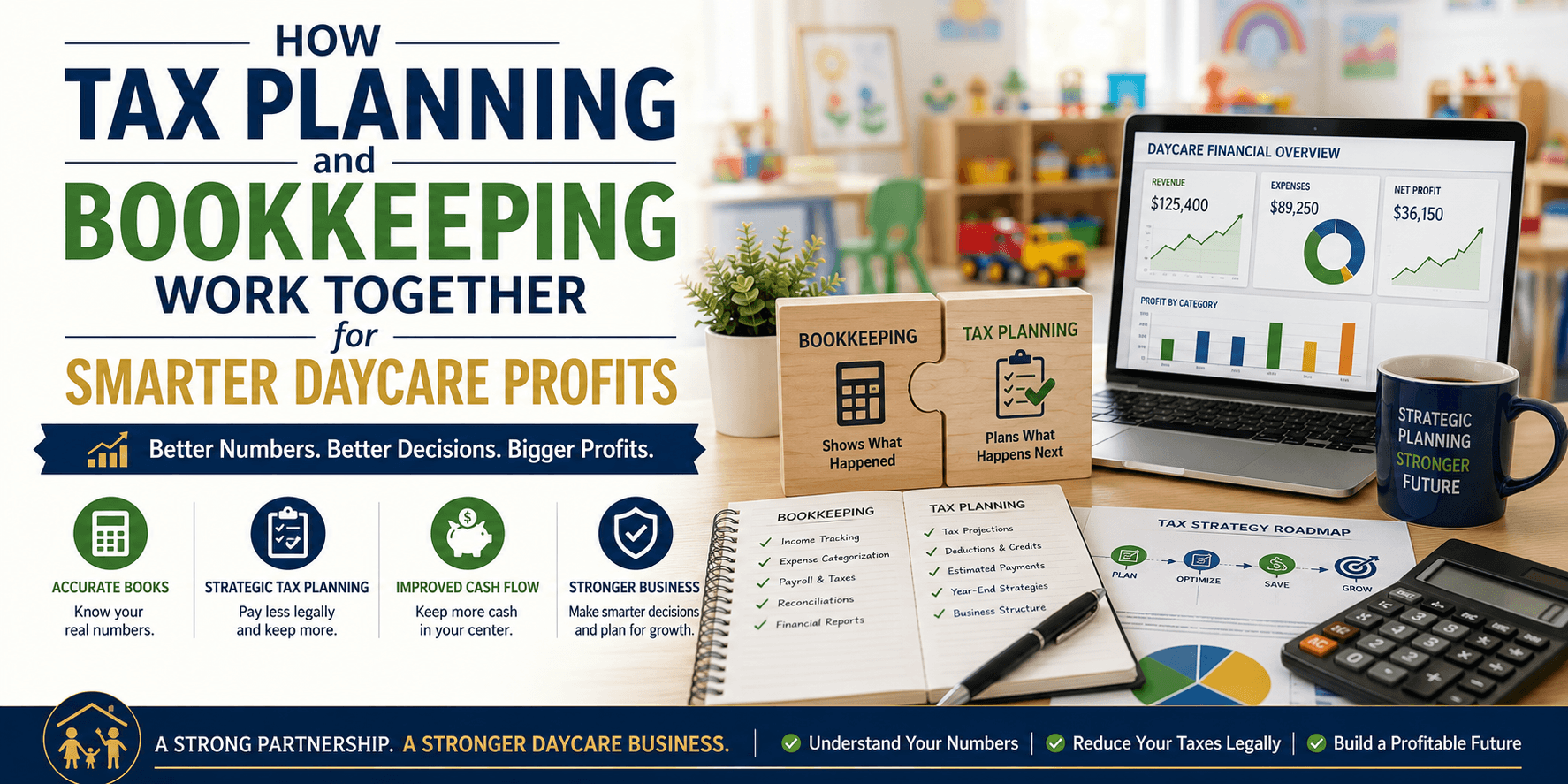
Bookkeeping shows what has already happened in the business. Tax planning uses that information to help the owner make better decisions before tax deadlines arrive.
When the two functions work together throughout the year, a daycare owner can better understand the center’s real profit, prepare for tax obligations, identify legitimate deductions, and decide when the business can safely hire, expand, invest, or increase owner compensation.
Bookkeeping and Tax Planning Have Different Jobs
Bookkeeping and tax planning are closely connected, but they are not the same service.
Bookkeeping organizes the financial activity
Daycare bookkeeping records and categorizes transactions such as:
- Parent tuition and registration fees
- Subsidy and government program payments
- Payroll and employer payroll taxes
- Classroom supplies and educational materials
- Meals and snacks
- Rent, mortgage-related expenses, and utilities
- Insurance and licensing fees
- Repairs, cleaning, and maintenance
- Software and payment-processing fees
- Owner contributions and withdrawals
A well-maintained bookkeeping system should clearly show the business’s income and expenses. The IRS allows businesses to choose a recordkeeping system that suits their operations, provided that the system clearly and accurately reflects financial activity.
Tax planning determines what to do next
Tax planning looks forward.
It considers questions such as:
- How much should the business reserve for taxes?
- Are estimated payments based on current profit?
- Is the owner’s compensation method still appropriate?
- Should equipment be purchased this year or next year?
- Are all eligible childcare expenses being documented?
- Could the business structure be creating unnecessary tax costs?
- How will hiring another employee affect payroll taxes and cash flow?
- What records will be needed to support deductions?
Bookkeeping supplies the numbers. Tax planning turns those numbers into decisions.
Without accurate books, tax planning is based on estimates and assumptions. Without tax planning, bookkeeping may become little more than a historical record that no one uses until tax season.
Why Daycare Businesses Need Both
Childcare businesses have a financial structure that differs from many other small businesses.
Payroll is often the largest operating expense. Staffing levels may be tied to classroom ratios and licensing requirements. Revenue depends on enrollment, attendance, age groups, tuition rates, subsidy schedules, and payment collection.
A daycare may also have expenses that require careful tracking, including food-program reimbursements, classroom materials, employee training, licensing costs, playground equipment, transportation, and building expenses.
Home-based daycare providers face another layer of complexity. IRS Publication 587 includes specific rules for daycare businesses that regularly use part of a home, even when the space is not used exclusively for business. The calculation may require both a space percentage and a time-use percentage.
These details cannot be handled properly when all transactions are placed into broad categories such as “supplies,” “miscellaneous,” or “business expenses.”
A daycare-specific bookkeeping system gives the tax strategist enough detail to see what is really happening.
How Monthly Bookkeeping Creates Better Tax Decisions
Tax planning is most effective when financial records are updated monthly rather than reconstructed after the year has ended.
Consider a childcare center that appears to be earning a healthy profit because tuition revenue has increased. After the books are reconciled, the owner discovers that:
- Overtime has increased significantly.
- Payment-processing fees have risen.
- Several classrooms are operating below capacity.
- Supply spending is higher than budgeted.
- Payroll tax liabilities have not been fully reserved.
- Owner withdrawals are being mistaken for business expenses.
The daycare may still be profitable, but not by as much as the bank deposits suggested.
Accurate monthly reports allow the owner and tax professional to calculate projected taxable income using current information. They can then adjust tax reserves, review estimated payments, and discuss available strategies before the year ends.
This is much more useful than discovering the problem while preparing the tax return.
The Three Reports That Connect Bookkeeping to Tax Planning
A daycare owner does not need to become an accountant. However, the owner should regularly review three financial reports.
1. Profit and Loss Statement
The profit and loss statement shows revenue, expenses, and net profit over a specific period.
For tax planning, this report helps estimate how much taxable business income the daycare may generate. It can also reveal unusual changes in payroll, supplies, food, maintenance, professional fees, or other expenses.
The report should be compared with prior months and the same period from the previous year. A single monthly number rarely tells the complete story.
2. Balance Sheet
The balance sheet shows what the daycare owns, what it owes, and the owner’s equity in the business.
It may include:
- Bank balances
- Outstanding parent balances
- Loans
- Credit cards
- Payroll liabilities
- Tax liabilities
- Equipment
- Owner contributions
- Owner distributions
A daycare can report a profit while still struggling to pay bills. The balance sheet helps explain where the money went and whether the business is carrying debt or unpaid obligations.
3. Cash Flow Statement
The cash flow statement explains how cash moved through the business.
This matters because taxable profit and available cash are not always the same.
For example, the daycare may have used cash to repay a loan, purchase equipment, or make owner distributions. Those transactions can reduce the bank balance without reducing taxable profit in the same way as a normal operating expense.
A tax estimate based only on the current bank balance can therefore be misleading.
Better Bookkeeping Helps Protect Daycare Tax Deductions
A business deduction is not created simply because a purchase was made with a business debit card.
The expense must generally be connected to the business and supported by appropriate records. IRS guidance states that deductible business expenses must be ordinary and necessary for the business. Personal and family expenses are generally not deductible.
For daycare owners, commonly reviewed expense categories may include:
- Employee wages and payroll taxes
- Substitute teacher costs
- Classroom and educational supplies
- Meals and snacks provided to children
- Cleaning and sanitation supplies
- Licensing and inspection fees
- Employee background checks
- Continuing education and training
- Business insurance
- Accounting, legal, and professional services
- Advertising and enrollment-related expenses
- Software and parent-communication systems
- Repairs and maintenance
- Business-related vehicle use
- Qualified home-daycare expenses
- Furniture, appliances, playground equipment, and other assets
Whether a particular expense is deductible—and how it must be reported—depends on the facts, business structure, documentation, and applicable tax rules.
That is why useful bookkeeping should do more than assign a generic category. It should preserve enough information for the tax professional to understand the transaction.
For example, “Target – $684” is not a useful description by itself.
A better record would show that the purchase included classroom storage bins, art supplies, cleaning products, and personal household items. The business and personal portions could then be separated while the information is still available.
Home-Daycare Bookkeeping Requires Special Attention
Home-based childcare providers should not treat their home expenses like a standard office deduction.
Qualified daycare providers may be able to calculate business use of the home even when daycare areas are also used personally. However, regular use, licensing or exemption requirements, space, time, and the nature of each expense may affect the calculation.
Proper records may include:
- Total square footage of the home
- Square footage used regularly for daycare
- Rooms and areas available for daycare activities
- Business hours
- Additional preparation and cleaning time when applicable
- Rent or mortgage-related information
- Property taxes
- Utilities
- Homeowners or renters insurance
- Repairs and maintenance
- Direct improvements to daycare areas
- Meals and snacks provided to enrolled children
Publication 587 also explains that food provided to daycare recipients is handled separately from the business-use-of-home calculation. Eligible providers may use actual food costs or applicable standard meal and snack rates, subject to the rules.
Waiting until tax season to recreate an entire year of operating hours, meal records, receipts, and household expenses increases the risk of missing information.
Payroll Records Affect Both Profit and Tax Risk
Payroll is not only an expense. It also creates tax filing, deposit, and recordkeeping responsibilities.
Federal employment taxes generally include withheld federal income tax and the employer and employee portions of Social Security and Medicare taxes.
The bookkeeping records should regularly reconcile:
- Gross wages
- Employee withholdings
- Employer payroll taxes
- Payroll-service withdrawals
- Tax deposits
- Benefit deductions
- Payroll liabilities
- Payroll reports and tax filings
Errors can occur when a payroll withdrawal is recorded as one large wage expense without separating wages, employer taxes, employee withholdings, service fees, and liabilities.
Worker classification also matters. The IRS requires business owners to determine whether workers should be treated as employees or independent contractors based on the actual working relationship. Simply calling a teacher or assistant a contractor does not make the classification correct.
Because childcare centers typically control schedules, procedures, classroom responsibilities, and how care is provided, classification questions should be reviewed carefully with a qualified professional.
Bookkeeping Makes Estimated Taxes More Predictable
Many daycare owners approach estimated taxes in one of two ways:
They send the same amount every quarter without checking current profit, or they send nothing and hope the final tax bill is manageable.
Neither method provides much control.
Businesses and self-employed taxpayers may need to make estimated payments during the year, and underpayment can result in penalties.
A better process is to review year-to-date financial results at planned intervals.
The tax professional can consider:
- Current net profit
- Expected enrollment changes
- Planned hiring
- Owner compensation
- Prior-year tax information
- Investments or equipment purchases
- Other household income
- Available tax credits or deductions
- State and local tax obligations
This helps the daycare build a realistic tax reserve instead of treating the tax bill as an unexpected emergency.
A Practical Example
Assume a daycare center collects $85,000 in monthly revenue.
After reviewing the bank account, the owner believes the center is keeping approximately $18,000 per month. But the reconciled books show:
- $48,000 in wages and payroll costs
- $7,500 in rent and occupancy expenses
- $4,800 in food and classroom supplies
- $3,700 in insurance, software, and professional expenses
- $3,000 in repairs and other operating costs
- $4,500 in owner withdrawals
The actual monthly operating profit is $18,000 before considering how certain transactions should be treated for tax purposes. The owner withdrawal is not automatically an additional business expense simply because money left the company.
The tax strategist can now work with a much clearer figure.
The owner may decide to:
- Increase the tax reserve.
- Adjust estimated payments.
- Review the owner compensation structure.
- Delay a nonessential personal withdrawal.
- Evaluate a planned equipment purchase.
- Investigate overtime costs.
- Improve enrollment in an underused classroom.
- Create a cash reserve before hiring another employee.
The bookkeeping did not merely prepare the business for a tax return. It changed how the owner managed the daycare.
Important Tax Planning Decisions Should Happen Before Year-End
Some tax strategies cannot be handled effectively after December 31.
Depending on the daycare’s circumstances, year-round planning may involve reviewing:
- Business entity structure
- Owner salary or distributions
- Retirement-plan contributions
- Employee benefit options
- Equipment and facility investments
- Depreciation choices
- Timing of income and expenses
- Estimated tax payments
- Hiring plans
- Family members legitimately working in the business
- Health-insurance arrangements
- Expansion or property decisions
These strategies should never be selected simply because they sound like tax-saving ideas.
Every decision should be supported by the daycare’s actual financial records, operational needs, cash position, legal structure, and long-term goals.
Buying unnecessary equipment to receive a deduction, for example, can still leave the business with less cash. A tax deduction usually reduces taxable income; it does not make the purchase free.
A Year-Round Bookkeeping and Tax Planning Schedule
A practical schedule can keep the process manageable.
Every week
Record deposits, save receipts, review unpaid tuition, and separate business purchases from personal spending.
Every month
Reconcile bank, credit-card, loan, and payroll accounts. Review the profit and loss statement, balance sheet, and cash flow.
Every quarter
Compare actual results with the budget. Review tax projections, estimated payments, payroll costs, enrollment, owner withdrawals, and planned purchases.
Before major decisions
Consult the bookkeeping and tax records before hiring, changing tuition, purchasing equipment, opening another location, signing a lease, or taking a large owner distribution.
Before year-end
Complete a detailed tax-planning review while there is still time to implement appropriate strategies.
At tax-filing time
Provide reconciled, tax-ready books rather than a collection of bank statements and receipts.
Signs Your Bookkeeping Is Not Supporting Tax Planning
Your current system may need improvement when:
- The books are several months behind.
- Bank and credit-card accounts are not reconciled.
- Payroll reports do not match the general ledger.
- Subsidies and tuition are combined without detail.
- Owner withdrawals are recorded as expenses.
- Personal and business purchases are mixed together.
- Large amounts are repeatedly placed in “miscellaneous.”
- Financial reports change significantly after tax adjustments.
- Estimated taxes are based only on the previous year.
- No one reviews the books until the tax return is due.
- The owner cannot explain the difference between profit and cash.
These problems do not always mean the daycare is unprofitable. They mean the owner may be making decisions without reliable information.
Smarter Daycare Profits Begin With Better Financial Coordination
Tax planning cannot repair incomplete bookkeeping at the last minute.
Bookkeeping cannot reduce taxes simply by recording transactions.
The real value appears when both services operate as one coordinated financial process.
Accurate daycare bookkeeping shows where the business earns money, where cash is being consumed, and which expenses require better documentation. Strategic tax planning uses that information to anticipate obligations, evaluate opportunities, and help the owner keep more of the profit the business has genuinely earned.
Daycare AccountingPRO provides bookkeeping designed for the childcare industry, along with strategic tax planning and year-round financial guidance. Instead of waiting until tax season to discover what happened, childcare owners can use current financial information to make more informed decisions throughout the year.
Schedule a tax strategy consultation with Daycare AccountingPRO to review your bookkeeping, projected tax liability, cash flow, and opportunities for a more profitable financial plan.
This article provides general educational information and should not be treated as individualized tax, legal, or accounting advice. Tax treatment depends on the specific facts and applicable federal, state, and local rules.