Tax Planning Mistakes Daycare Owners Make and How to Avoid Them

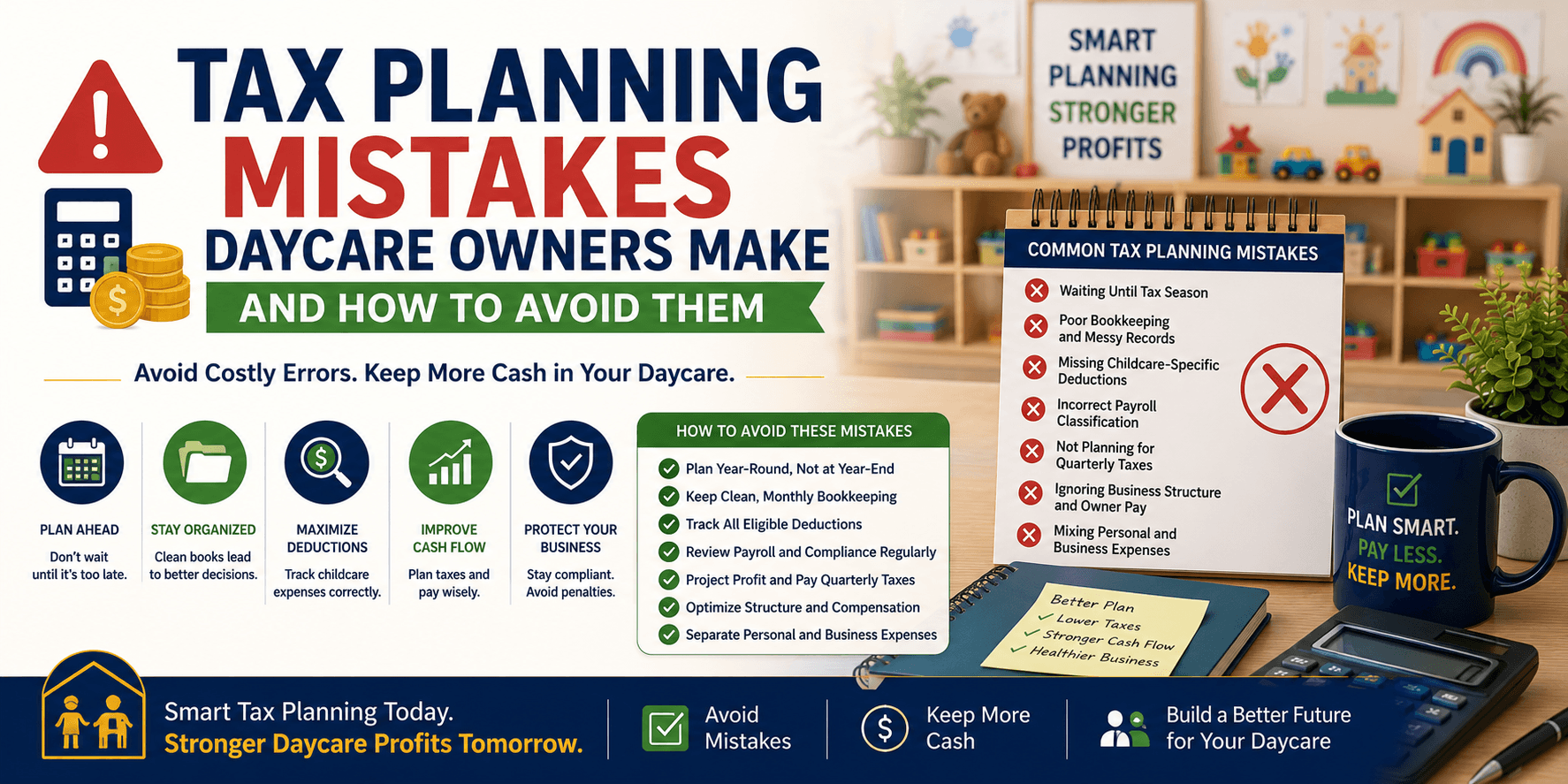
Daycare owners rarely make tax mistakes because they do not care about their finances.
Most mistakes happen because the owner is managing too many responsibilities at once.
A childcare business requires constant attention to enrollment, staffing ratios, payroll, licensing, parent communication, classroom needs, safety, meals, facility maintenance, and cash flow. When the day is over, bookkeeping and tax planning are often pushed to the bottom of the list.
That delay can become expensive.
A missing receipt may seem insignificant. An inaccurate payroll category may appear harmless. An estimated tax payment based on last year’s numbers may feel close enough. But over several months, small financial mistakes can lead to missed deductions, inaccurate reports, cash shortages, payroll problems, penalties, and unpleasant tax-season surprises.
The most damaging tax mistake is often not a single incorrect transaction. It is operating the daycare without a reliable year-round financial process.
Below are some of the most common tax planning mistakes daycare owners make, why they happen, and how to prevent them.
1. Treating Tax Preparation as Tax Planning
Many daycare owners believe they are receiving tax planning because they meet with a tax preparer once a year.
Tax preparation and tax planning are not the same.
Tax preparation reports what already happened. By the time the return is being prepared, the tax year has generally ended and many useful decisions can no longer be changed.
Tax planning happens before the year is over.
It may involve reviewing:
- Current business profit
- Estimated tax payments
- Owner compensation
- Payroll
- Equipment purchases
- Retirement contributions
- Business structure
- Tax credits
- Home-daycare expenses
- Timing of income and expenses
- Cash available for taxes
A tax preparer can accurately report the numbers provided. However, filing an accurate return does not automatically mean the business used every appropriate planning opportunity.
How to avoid this mistake
Schedule tax-planning reviews during the year, not only after December 31.
A useful minimum for many established childcare businesses is a quarterly review aligned with the daycare’s financial reports and estimated tax schedule.
During each review, ask:
- What is the daycare’s projected annual profit?
- How much tax may be due if nothing changes?
- Are estimated payments still appropriate?
- Are there decisions that must be completed before year-end?
- Is the daycare’s current business structure still suitable?
- How much cash should be reserved for taxes?
The purpose is to make decisions while there is still time to act.
2. Making Tax Decisions From the Bank Balance
A strong bank balance does not necessarily mean the daycare is highly profitable.
A low bank balance does not necessarily mean the business has no taxable profit.
Cash and taxable profit are connected, but they are not the same.
For example, cash may increase because the daycare:
- Received loan proceeds
- Collected tuition in advance
- Received a grant
- Delayed paying a bill
- Received an owner contribution
Those deposits may not all represent current operating profit.
Cash may decrease because the daycare:
- Repaid loan principal
- Purchased equipment
- Made an owner distribution
- Paid a prior-year liability
- Transferred money into savings
Those withdrawals may not all reduce current taxable income.
An owner who looks only at the bank account may believe there is plenty of money available for distributions. A few weeks later, the business may still need to fund payroll, payroll taxes, rent, insurance, and estimated taxes.
How to avoid this mistake
Review three reports together:
- Profit and loss statement: Shows revenue, expenses, and accounting profit.
- Balance sheet: Shows cash, debt, assets, liabilities, and owner equity.
- Cash flow report: Helps explain why the bank balance changed.
Before taking a large owner withdrawal or making a major purchase, review all three reports and prepare a short-term cash forecast.
3. Allowing Bookkeeping to Fall Months Behind
Tax planning is difficult when the most recent reliable financial report is three, six, or nine months old.
A daycare’s finances can change quickly.
Enrollment may rise while payroll rises even faster. A classroom may appear full but operate at a weak margin. Overtime may increase. Food costs may climb. Subsidy payments may be delayed. Repairs may consume the center’s reserve.
When the books are behind, the tax estimate is based on assumptions rather than current information.
The IRS notes that good records help businesses monitor performance, identify income, track deductible expenses, prepare financial statements, and support information reported on tax returns. Businesses may choose a recordkeeping system that fits their needs, but it must clearly show income and expenses.
How to avoid this mistake
Complete the following every month:
- Record all income and expenses.
- Reconcile each bank account.
- Reconcile every business credit card.
- Reconcile loans and lines of credit.
- Match payroll reports to the accounting records.
- Review uncategorized transactions.
- Separate owner activity from operating expenses.
- Produce a profit and loss statement and balance sheet.
Monthly bookkeeping gives the tax professional usable numbers before planning deadlines pass.
4. Using Categories That Are Too General
A financial report filled with categories such as “miscellaneous,” “supplies,” and “other expense” is not truly tax-ready.
Daycare businesses have many different types of expenses:
- Classroom materials
- Curriculum
- Cleaning supplies
- Food
- Staff training
- Licensing
- Background checks
- Software
- Insurance
- Repairs
- Playground maintenance
- Office supplies
- Furniture
- Equipment
- Marketing
- Payment-processing fees
When all these costs are combined, important details disappear.
A $12,000 “supplies” balance does not tell the owner whether spending went toward food, curriculum, sanitation, furniture, or equipment. It also does not help the tax professional determine whether every item should receive the same tax treatment.
How to avoid this mistake
Use a chart of accounts designed for childcare businesses.
At minimum, separate:
- Private-pay tuition
- Subsidy revenue
- Registration and activity fees
- Food-program reimbursements
- Wages
- Employer payroll taxes
- Classroom supplies
- Meals and snacks
- Licensing and compliance
- Staff development
- Cleaning and sanitation
- Repairs and maintenance
- Furniture and equipment
- Professional services
The goal is not to create hundreds of categories. The goal is to create enough meaningful detail to support tax planning and business decisions.
5. Mixing Personal and Business Expenses
Using one account for both business and personal spending creates avoidable confusion.
This is especially common with:
- Grocery purchases
- Online marketplaces
- Warehouse clubs
- Fuel
- Mobile phone bills
- Internet
- Home-improvement stores
- Restaurants
- Vehicle expenses
- Household utilities
A daycare owner may make a legitimate business purchase and a personal purchase in the same transaction. If the entire amount is recorded as a business expense, the financial report overstates deductions.
The opposite problem also occurs. An owner may pay for daycare supplies personally and never record the business portion, causing a legitimate expense to be missed.
How to avoid this mistake
Use separate business bank and credit-card accounts.
When a mixed purchase cannot be avoided:
- Keep the itemized receipt.
- Identify the business items.
- Remove the personal portion.
- Record the personal amount as an owner draw or distribution.
- Document the business purpose of the remaining amount.
When the owner pays a business cost personally, submit it through a consistent reimbursement or owner-contribution process.
6. Assuming Every Purchase Is Deductible
Paying for something from a business account does not automatically make it a deductible business expense.
A deductible business cost generally must be ordinary and necessary. An ordinary expense is common and accepted in the business, while a necessary expense is helpful and appropriate.
Daycare owners can run into problems with:
- Personal meals
- Family travel
- Clothing that can be worn outside work
- Home renovations unrelated to daycare
- Personal vehicle expenses
- Gifts without documentation
- Personal subscriptions
- Expenses shared with another business
- Purchases with no clear business purpose
The deduction depends on what was purchased, how it was used, who benefited, and whether the owner can support the business purpose.
How to avoid this mistake
For every unusual or significant expense, preserve:
- Vendor name
- Date
- Amount
- Itemized receipt
- Proof of payment
- Description of what was purchased
- Explanation of the business purpose
When an expense has both personal and business use, deduct only the properly supported business portion.
7. Missing Legitimate Childcare Business Expenses
Some daycare owners overstate expenses. Others understate them.
Underreporting often happens because the owner pays for small purchases personally or forgets to submit receipts.
Commonly overlooked areas may include:
- Licensing fees
- Inspection fees
- Staff background checks
- CPR and first-aid training
- Continuing education
- Classroom decorations
- Curriculum subscriptions
- Educational toys
- Books
- Cleaning and sanitation products
- Security monitoring
- Parent-communication software
- Payroll software
- Website costs
- Advertising
- Bank fees
- Merchant-processing fees
- Professional memberships
- Business insurance
- Professional services
Whether a particular expense is deductible depends on the facts and the applicable rules. However, the tax professional cannot evaluate an expense that was never recorded.
How to avoid this mistake
Create a simple receipt process.
Owners and authorized staff should be able to:
- Photograph a receipt immediately.
- Upload it to the accounting system.
- Select the location or classroom.
- Add a short business-purpose note.
- Identify whether reimbursement is needed.
Review owner-paid expenses monthly rather than trying to reconstruct them at tax time.
8. Failing to Reconcile Payroll
Payroll may be the largest expense in a childcare center.
It is also one of the areas where bookkeeping errors can create both inaccurate financial reports and tax-compliance problems.
A payroll withdrawal from the bank may contain:
- Net employee pay
- Federal withholding
- State withholding
- Employee Social Security and Medicare
- Employer Social Security and Medicare
- Unemployment taxes
- Retirement contributions
- Insurance deductions
- Payroll-service fees
Recording the entire withdrawal as “wages” does not accurately show these components.
The result may be:
- Overstated wage expense
- Missing payroll liabilities
- Incorrect employer tax expense
- Differences between the books and payroll returns
- Confusion when Forms W-2 are prepared
How to avoid this mistake
Reconcile payroll after every payroll period or at least monthly.
Compare:
- Gross wages in payroll reports
- Gross wages in the general ledger
- Employer payroll taxes
- Employee deductions
- Net pay
- Payroll-service fees
- Tax deposits
- Outstanding payroll liabilities
At the end of each quarter, compare the books with the payroll tax filings before the next quarter begins.
9. Misclassifying Employees as Independent Contractors
A daycare owner may classify someone as a contractor because:
- The person works part time.
- The position is temporary.
- The worker requested contractor status.
- The worker signed a contractor agreement.
- Paying through accounts payable seems easier than payroll.
None of those facts determines classification by itself.
The IRS considers the full working relationship and the degree of control and independence. A written contract calling someone an independent contractor is not enough when the actual relationship shows otherwise.
This issue deserves special attention in childcare because teachers, assistants, substitutes, and administrative staff may work under the daycare’s schedule, procedures, supervision, licensing standards, and classroom rules.
How to avoid this mistake
Review workers based on the actual relationship.
Consider:
- Who determines the schedule?
- Who controls how the work is performed?
- Who provides tools and supplies?
- Is the work a central part of the daycare’s regular operations?
- Can the worker experience a business profit or loss?
- Does the worker provide similar services to other clients?
- Is the relationship ongoing?
When classification remains uncertain, consult a qualified tax and employment professional. The IRS also provides Form SS-8 for requesting a federal worker-status determination in appropriate cases.
For legitimate contractors, collect Form W-9 before or at the beginning of the engagement. The IRS recommends keeping the form in the business’s files.
10. Guessing Quarterly Estimated Tax Payments
Some daycare owners make no estimated payments.
Others continue sending the same amount used several years ago.
A third group intentionally sends too much because they are afraid of owing at tax time.
All three approaches can create problems.
Estimated tax should reflect expected income, deductions, taxes, and credits for the current year. When earnings change, the estimate can be recalculated for later payment periods.
A daycare’s results may change because of:
- Enrollment growth
- Tuition increases
- Wage increases
- Staff shortages
- New classrooms
- Facility repairs
- Grants
- Equipment purchases
- Changes in owner compensation
- Expansion into a second location
A payment based only on last year’s return may no longer fit the business.
How to avoid this mistake
Complete a tax projection during the year using:
- Current year-to-date profit
- Expected revenue for the remaining months
- Expected payroll
- Planned purchases
- Owner compensation
- Other household income
- Prior estimated payments
- Federal and state withholding
- Available deductions and credits
Update the projection when a significant change occurs.
The goal is not to predict the final tax bill down to the exact dollar. The goal is to prevent major surprises and preserve enough cash to pay the expected obligation.
11. Failing to Maintain a Tax Reserve
A daycare can be profitable and still be unable to pay its taxes.
This often happens when the owner spends or withdraws cash before considering:
- Estimated taxes
- Payroll taxes
- State taxes
- Annual insurance payments
- Licensing renewals
- Debt payments
- January payroll
- Facility repairs
The bank balance may look available, but part of that cash may already be committed.
How to avoid this mistake
Create a separate tax savings account.
After each monthly or quarterly tax projection:
- Calculate the amount that should be reserved.
- Compare it with the current tax savings balance.
- Transfer the difference.
- Avoid using the account for normal operating costs.
The exact reserve percentage should be based on the daycare’s entity type, profit, owner compensation, other household income, and state tax obligations. A single percentage does not fit every daycare owner.
12. Choosing a Business Entity Based on Social Media Advice
Daycare owners regularly hear that one entity type is always better than another.
The decision is more complicated.
A business structure can affect:
- How the business files taxes
- How the owner is paid
- Payroll requirements
- Self-employment tax
- Administrative costs
- State fees
- Legal responsibilities
- Retirement-plan options
- Recordkeeping
- The treatment of distributions
An entity that works well for one childcare owner may create unnecessary cost and complexity for another.
For example, a structure that creates possible tax benefits at a certain profit level may not be worthwhile when the business has inconsistent profit, limited cash, high compliance costs, or no reliable payroll system.
How to avoid this mistake
Review the structure using the daycare’s actual numbers.
The analysis should include:
- Current annual profit
- Expected future profit
- Owner compensation needs
- Payroll cost
- State filing fees
- Tax-preparation costs
- Bookkeeping requirements
- Retirement goals
- Expansion plans
- Legal advice
Do not change the entity based only on a generic savings estimate.
13. Paying the Owner Incorrectly
Owners may transfer money from the daycare whenever personal bills are due.
Without proper classification, these transfers can create confusing records.
Depending on the business structure, owner payments may be:
- Draws
- Distributions
- Guaranteed payments
- W-2 wages
- Expense reimbursements
- Loan repayments
- Repayment of owner-paid costs
These categories are not interchangeable.
A transfer to the owner is not automatically a deductible business expense. Likewise, money the owner contributes to the business is not automatically revenue.
How to avoid this mistake
Create an owner-payment policy.
Decide:
- How often the owner will be paid
- Whether payroll is required
- How distributions will be approved
- How business expenses paid personally will be reimbursed
- How owner contributions will be documented
- How owner loans will be recorded
Review total owner compensation before the final payroll and before making a large distribution.
14. Buying Equipment Only to Receive a Tax Deduction
Near year-end, some business owners rush to purchase furniture, vehicles, computers, playground equipment, or appliances because they have been told to “spend money for the write-off.”
A deduction does not make the purchase free.
If a daycare spends $20,000 on equipment it does not need, it still loses cash or assumes debt. The tax benefit, when available, covers only part of the cost.
Equipment may also require different tax treatment from ordinary supplies. Timing can depend on when the property is ready and available for use, not merely when it was ordered.
How to avoid this mistake
Before approving a purchase, ask:
- Does the daycare need this item?
- Will it improve safety, capacity, quality, or efficiency?
- Can the daycare afford it after taxes and payroll?
- Will it be ready for use before year-end?
- Is it equipment, a repair, or an improvement?
- Is financing affordable?
- Would the purchase make more operational sense next year?
- Is a grant or reimbursement available?
Make the business decision first. Then review the tax treatment.
15. Recording Improvements as Routine Repairs
A daycare facility requires frequent maintenance.
However, replacing an entire system may not receive the same treatment as repairing one damaged part.
Potential examples include:
- Repairing a section of flooring versus replacing flooring throughout the center
- Repairing a fence versus installing a new perimeter
- Servicing an HVAC unit versus replacing the system
- Patching a playground surface versus completing a major renovation
- Repairing a sink versus remodeling the kitchen
- Replacing a damaged door versus redesigning the entrance
Placing every property-related cost into “repairs and maintenance” can produce inaccurate reporting.
How to avoid this mistake
Keep detailed documentation for facility work:
- Estimates
- Contracts
- Itemized invoices
- Before-and-after photographs
- Description of the problem
- Scope of work
- Completion date
- Date the improvement became usable
- Financing documents
Your tax professional can then determine whether the cost should be deducted, capitalized, depreciated, or treated another way.
16. Miscalculating the Home-Daycare Deduction
Family daycare providers have special rules that differ from the standard home-office rules.
A qualifying daycare provider may use part of the home regularly for daycare without meeting the usual exclusive-use requirement. However, licensing, certification, registration, approval, regular use, space, and time can all affect eligibility and calculation.
Common mistakes include:
- Using the full home square footage without support
- Counting rooms that are only used occasionally
- Forgetting preparation and cleaning time
- Using scheduled hours instead of actual operating records
- Including periods when the daycare was closed
- Failing to document licensing or exemption status
- Treating every home repair as fully deductible
- Combining meal costs with home-use expenses
How to avoid this mistake
Maintain records throughout the year for:
- Total home square footage
- Daycare-use areas
- How each area is regularly used
- Days open
- Operating hours
- Preparation time
- Cleaning time
- Administrative time
- Parent conferences
- Closure dates
- Rent or mortgage-related records
- Utilities
- Insurance
- Repairs
- Maintenance
Publication 587 explains that when space is used regularly but not exclusively for daycare, the calculation may need to account for both space and time.
Do not wait until tax season to recreate an entire year from memory.
17. Combining Food Costs and Food-Program Reimbursements Incorrectly
Meals and snacks are a major area of spending for many childcare businesses.
Problems arise when the owner:
- Records only the net amount after reimbursement
- Fails to separate reimbursements from tuition
- Includes meals consumed by the owner’s family
- Does not maintain attendance or meal counts
- Mixes household groceries with daycare food
- Records all grocery spending as a daycare expense
- Uses an allowance without confirming the applicable rules
For a home-based daycare, food provided to daycare recipients is handled separately from the business-use-of-home calculation. Publication 587 includes specific guidance for family daycare meal and snack expenses.
How to avoid this mistake
Maintain consistent records for:
- Children in attendance
- Meals and snacks served
- Food-program claims
- Reimbursements received
- Grocery receipts
- Personal portions of mixed purchases
- The method used to calculate eligible food costs
Record reimbursements and related expenses clearly so the financial reports show the daycare’s actual food cost.
18. Estimating Business Mileage at Tax Time
A daycare owner may use a vehicle to:
- Buy classroom supplies
- Attend training
- Travel between locations
- Transport children
- Visit the bank
- Meet with professionals
- Complete licensing requirements
At tax time, the owner may estimate the year’s mileage using memory.
That approach can result in either a missed deduction or an unsupported number.
How to avoid this mistake
Use a mileage application or written log.
Record:
- Date
- Destination
- Business purpose
- Beginning and ending mileage
- Total business miles
- Parking
- Tolls
Keep records close to the time of travel. Review the log monthly and confirm total annual vehicle mileage at year-end.
The IRS may update the standard business mileage rate from year to year, so use the rate for the correct tax period rather than reusing an old amount.
19. Missing Retirement-Plan Deadlines
A retirement plan can support the owner’s long-term goals and may also help a daycare compete for employees.
However, plan establishment, employee notice, payroll, contribution, and filing requirements vary.
Waiting until the tax return is being prepared may be too late for some options or actions.
Available structures may include:
- SEP IRA
- SIMPLE IRA
- 401(k)
- One-participant 401(k)
- Other qualified plans
The appropriate plan depends on the business structure, employees, compensation, contribution goals, and administrative capacity. The IRS provides separate guidance for retirement plans available to small businesses and self-employed individuals.
Eligible employers may also qualify for a federal credit for certain costs of starting a qualified retirement plan, subject to the requirements and limitations.
How to avoid this mistake
Discuss retirement planning before year-end.
Ask:
- Which employees must be included?
- What employer contribution is required?
- What is the establishment deadline?
- What notices are required?
- How will contributions affect cash flow?
- What administrative costs apply?
- Is a startup credit potentially available?
Do not select a plan based only on the maximum advertised contribution.
20. Ignoring State and Local Tax Responsibilities
Federal taxes receive most of the attention, but daycare businesses may also have state and local obligations.
Depending on the location and activities, those may involve:
- State income tax
- Franchise or entity taxes
- Payroll withholding
- Unemployment tax
- Local business tax
- Sales or use tax
- Property tax
- Registration renewals
- Local filing requirements
Rules can differ significantly by state and municipality.
A daycare with employees in another state, a second location, or a change in business structure may create new filing responsibilities.
How to avoid this mistake
Include state and local obligations in the tax calendar.
Review responsibilities whenever the daycare:
- Opens another location
- Hires a remote employee
- Moves
- Changes entity type
- Buys property
- Adds transportation
- Receives a large grant
- Expands into another jurisdiction
Do not assume the federal tax preparer is automatically handling every state or local filing.
21. Taking Large Distributions Before Completing a Tax Projection
A successful enrollment period may produce a strong bank balance.
The owner may take a large distribution, pay personal bills, or make a personal investment. Later, the tax projection reveals that much of the remaining cash is needed for taxes.
The business may then have to borrow money or reduce operating reserves.
How to avoid this mistake
Before taking a significant distribution, calculate:
- Projected annual profit
- Expected tax liability
- Estimated payments already made
- Payroll due
- Payroll taxes due
- Accounts payable
- Loan payments
- Insurance renewals
- Planned repairs
- Required operating reserve
The amount available for distribution should be determined after these obligations are considered.
22. Failing to Review Prior Tax Returns
A daycare owner may continue using the same approach year after year without examining whether prior returns contain:
- Missed depreciation
- Inconsistent asset records
- Incorrect owner compensation
- Unused carryovers
- Missing elections
- Repeated bookkeeping adjustments
- Inconsistent entity reporting
- Expenses that were not considered
- Credits that may require further review
A prior return should not be amended simply because another strategy appears preferable. Changes must be supported by the law, documentation, and the specific facts.
However, reviewing prior filings can reveal patterns that should be corrected going forward.
How to avoid this mistake
During a comprehensive tax-planning engagement, provide:
- Prior federal returns
- Prior state returns
- Depreciation schedules
- Payroll returns
- Entity formation documents
- Loan documents
- Prior-year financial statements
- Notices from tax authorities
Ask the tax professional to identify both prior concerns and current-year planning opportunities.
23. Assuming the Accountant Knows About Every Business Change
A tax professional cannot plan for information that was never provided.
Daycare owners sometimes forget to mention:
- A new location
- A major equipment purchase
- A new loan
- A grant
- A vehicle purchase
- A change in ownership
- A family member joining the business
- A retirement plan
- A large personal withdrawal
- A new state
- A facility renovation
- A change in payroll provider
These events can affect accounting, payroll, tax planning, or filing requirements.
How to avoid this mistake
Contact your tax and bookkeeping professionals before major decisions whenever possible.
Create a simple rule:
If the decision involves ownership, employees, financing, property, a large purchase, a new location, or a significant transfer of cash, discuss it before signing or paying.
Early communication gives the professional time to evaluate the options rather than documenting the outcome afterward.
24. Looking for Tax Savings Without Improving the Business
A tax strategy should support the daycare’s broader financial health.
Reducing taxes does not solve:
- Weak tuition pricing
- Excessive overtime
- Underused classrooms
- Poor collection practices
- High debt
- Inadequate reserves
- Uncontrolled owner withdrawals
- Unprofitable services
- Inaccurate payroll scheduling
A daycare may save money on taxes and still struggle financially if the underlying operation is not profitable.
How to avoid this mistake
Connect tax planning with financial management.
Review:
- Revenue by location
- Enrollment by classroom
- Payroll as a percentage of revenue
- Tuition collection
- Overtime
- Food cost
- Occupancy cost
- Debt payments
- Operating margin
- Cash reserve
- Owner compensation
The best tax plan is based on a financially healthy business, not a collection of last-minute deductions.
A Better Tax Planning Process for Daycare Owners
Avoiding these mistakes does not require the owner to become a tax professional.
It requires a consistent process.
Every week
- Save receipts.
- Record owner-paid expenses.
- Review unpaid tuition.
- Separate personal purchases.
- Upload financial documents.
Every month
- Reconcile bank and credit-card accounts.
- Reconcile payroll.
- Review the profit and loss statement.
- Review the balance sheet.
- Update the tax reserve.
- Investigate unusual transactions.
Every quarter
- Prepare a tax projection.
- Review estimated payments.
- Review payroll costs.
- Compare actual results with the budget.
- Discuss planned purchases.
- Review owner compensation and distributions.
Before year-end
- Complete a detailed tax-planning meeting.
- Review equipment and facility projects.
- Confirm retirement-plan deadlines.
- Review worker classifications.
- Update home-daycare records.
- Collect missing contractor documents.
- Confirm the amount reserved for taxes.
During tax preparation
- Provide reconciled books.
- Provide complete payroll reports.
- Provide asset documents.
- Provide home-daycare records.
- Ask about unexpected adjustments.
- Carry planning recommendations into the new year.
Quick Daycare Tax Planning Mistake Checklist
Review the following questions with your bookkeeper and tax strategist:
- Are the books current and reconciled?
- Is income separated by type?
- Are personal and business expenses separated?
- Are owner payments categorized correctly?
- Are large purchases documented?
- Does payroll match the accounting records?
- Are workers classified correctly?
- Are Forms W-9 on file for legitimate contractors?
- Are estimated taxes based on current profit?
- Is money reserved for taxes?
- Has the business structure been reviewed?
- Has owner compensation been reviewed?
- Are equipment and repairs categorized properly?
- Are home-daycare hours and spaces documented?
- Are food costs and reimbursements tracked separately?
- Is business mileage documented?
- Have retirement-plan deadlines been reviewed?
- Are state and local obligations included?
- Have prior returns been reviewed?
- Is tax planning connected to the daycare’s financial goals?
Avoiding Tax Mistakes Begins Before Tax Season
Most daycare tax problems do not begin when the return is filed.
They begin months earlier when bookkeeping falls behind, payroll is not reconciled, receipts disappear, estimated taxes are guessed, or major decisions are made without reviewing their financial impact.
The solution is not more tax-season paperwork.
It is a coordinated year-round system in which bookkeeping, payroll, tax planning, and financial management work together.
Daycare AccountingPRO provides childcare-specific bookkeeping and strategic tax-planning services designed around the realities of tuition, subsidies, staffing, licensing, home-daycare expenses, and business growth.
Schedule a tax-planning consultation with Daycare AccountingPRO to review your current books, projected tax liability, business structure, payroll, deductions, and opportunities before costly mistakes continue into another tax year.
This article provides general educational information and is not individualized tax, accounting, financial, employment, or legal advice. Tax rules and filing requirements can change, and their application depends on the specific facts. Consult qualified professionals regarding your daycare business.