Daycare Profit vs. Cash Flow: Why a Profitable Childcare Business Can Still Feel Cash-Strapped

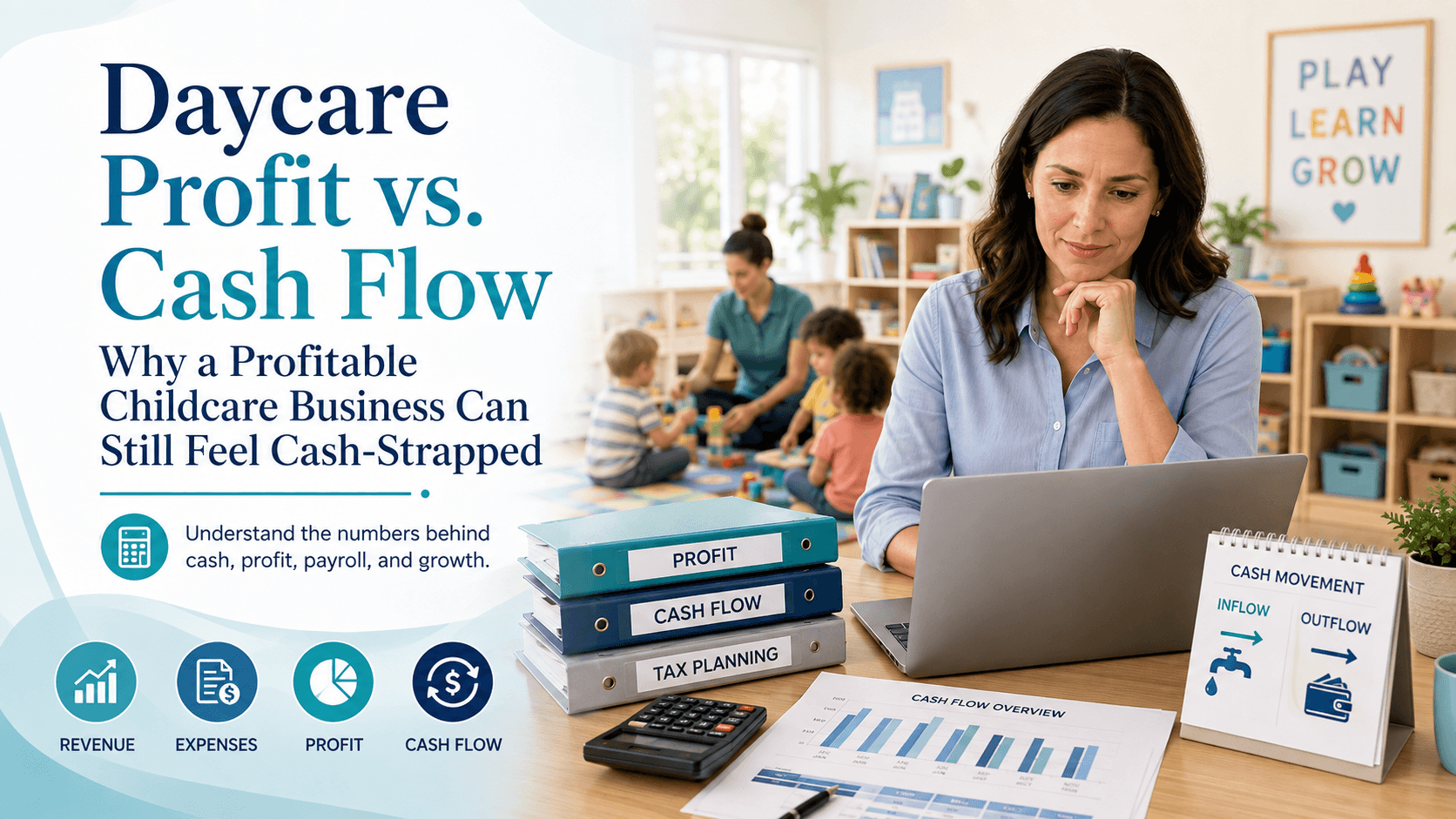
Your profit and loss statement says the childcare business made money.
Enrollment is strong.
Tuition is coming in.
The classrooms are busy.
Yet every time payroll approaches, you check the bank account and wonder:
Where did all the money go?
This is one of the most frustrating situations for a childcare business owner.
A center can generate a healthy accounting profit and still experience serious cash pressure. In fact, some growing childcare businesses feel more cash-strapped as revenue increases because payroll, debt payments, equipment purchases, taxes, and expansion costs are consuming cash at different times.
The problem is usually not that the financial statements are wrong.
The problem is that profit and cash flow measure two different things.
Understanding the difference between daycare profit and cash flow can help childcare owners make better decisions about hiring, tuition, tax reserves, owner distributions, debt, equipment purchases, and expansion.
And for a business where payroll often represents the largest operating expense, understanding that difference is especially important.
What Is Profit in a Childcare Business?
Profit is what remains after business revenue is reduced by the expenses recognized during a particular period.
In simple terms:
Revenue – Expenses = Profit
Suppose a childcare center generates $150,000 in revenue during a month and reports $130,000 of operating expenses.
The business may show approximately $20,000 of profit.
That tells the owner something important:
The business generated more revenue than the expenses recorded against that revenue.
But it does not necessarily mean another $20,000 appeared in the bank account.
That is where cash flow enters the picture.
What Is Cash Flow?
Cash flow tracks the actual movement of cash into and out of the childcare business.
Cash comes in through sources such as:
- Parent tuition
- Registration fees
- Childcare subsidies
- Food-program reimbursements
- Grants
- Loans
- Owner contributions
- Other program revenue
Cash leaves through:
- Payroll
- Payroll taxes
- Rent or mortgage payments
- Food
- Classroom supplies
- Insurance
- Equipment
- Loan payments
- Taxes
- Owner distributions
- Facility improvements
- Other operating expenses
Some cash transactions affect profit.
Others do not affect profit in the same way.
That distinction is the reason a profitable daycare may still have very little available cash.
A Simple Example: Profitable on Paper, Short on Cash
Consider a childcare center that begins the month with $50,000 in the bank.
During the month, the center collects:
$130,000 in tuition and other operating revenue.
Its normal operating expenses total:
$105,000.
The income statement may therefore show approximately:
$25,000 in operating profit.
The owner might reasonably expect the bank account to increase from $50,000 to approximately $75,000.
But during the same month, the center also:
- Pays $8,000 of loan principal
- Purchases $10,000 of playground equipment
- Makes a $12,000 owner distribution
- Pays $6,000 toward estimated taxes
Those transactions consume another $36,000 of cash.
Instead of increasing by $25,000, available cash may actually decline.
The childcare business can therefore be profitable and cash-strapped at the same time.
That is not an accounting contradiction.
It is a cash-flow issue.
Why This Happens Frequently in Childcare Businesses
Childcare businesses have several characteristics that make cash management especially important.
Payroll is large and frequent
Many centers have substantial payroll every one or two weeks.
Revenue may arrive gradually throughout the month, but payroll must be available on specific dates.
Staffing cannot always adjust immediately with enrollment
A classroom may lose several children, but the center may still need enough teachers to meet staffing and ratio requirements.
Revenue falls faster than payroll.
Subsidies may arrive on a different schedule
A provider may deliver childcare services before reimbursement arrives.
The business still needs to pay teachers, food costs, rent, and utilities while waiting.
Equipment can be expensive
Playground equipment, cribs, furniture, security systems, appliances, vehicles, flooring, and HVAC systems can require significant cash.
Taxes do not always leave the account when the income is earned
The business may earn profit throughout the quarter while the related estimated tax payment happens later.
Owners may withdraw cash without realizing how much is already committed
The bank balance may include money needed for payroll, taxes, insurance, debt, or upcoming repairs.
All of these factors can cause the bank account and profit-and-loss statement to tell very different stories.
Reason #1: Loan Principal Uses Cash but Usually Does Not Reduce Profit
Debt is one of the most common reasons for a difference between profit and cash flow.
Suppose your daycare has a business loan payment of $7,000 per month.
That payment may include:
- $5,800 of principal
- $1,200 of interest
The entire $7,000 leaves the bank account.
But the accounting treatment differs.
The principal portion generally reduces the loan balance on the balance sheet rather than functioning as a normal operating expense.
The interest portion may generally be treated as business interest when the debt and use of proceeds meet applicable requirements, subject to relevant limitations.
This creates a situation where the daycare can report profit but still use significant cash to repay debt.
Example
Suppose your daycare generates:
$300,000 in annual accounting profit.
But it also pays:
$100,000 of loan principal during the year.
Your bank account feels the entire $100,000 cash outflow even though that principal does not reduce profit like ordinary payroll or classroom supplies.
That is why debt service must be considered separately when determining how much cash the owner can safely withdraw.
Reason #2: Equipment Purchases Can Consume Cash Faster Than They Reduce Taxable Income
Imagine purchasing $30,000 of new playground equipment.
If you pay cash, the bank balance immediately falls by $30,000.
But the accounting and tax treatment may not necessarily show a $30,000 operating expense that same day.
Certain business assets are recovered through depreciation, although special expensing and depreciation provisions may apply depending on the property and circumstances.
IRS guidance explains that depreciation generally allows businesses to recover the cost of qualifying property over the period it is used. Depreciation generally begins when the asset is placed in service, meaning it is ready and available for its intended business use.
For childcare businesses, this can apply to items such as:
- Playground equipment
- Classroom furniture
- Kitchen appliances
- Computers
- Security equipment
- Vehicles
- HVAC systems
- Certain facility improvements
The cash leaves immediately.
The expense recognition may occur differently.
That creates another gap between profit and cash.
Reason #3: Owner Distributions Reduce Cash but Usually Are Not Operating Expenses
Another major source of confusion is owner withdrawals.
Suppose your childcare business earns $200,000.
During the year, you transfer $140,000 from the business bank account to your personal account.
Those transfers do not automatically create $140,000 of deductible expenses.
Depending on the business structure, they may represent:
- Owner draws
- Partner distributions
- Shareholder distributions
- Loan repayments
- Other equity transactions
The bank account falls by $140,000.
The business may still report substantial profit.
This is one of the biggest reasons owners say:
“If the business made that much money, why isn’t the money in the bank?”
Sometimes the answer is simple:
The profit was generated.
The cash was distributed.
Reason #4: Taxes May Be Owed Before You Feel Like You Have the Money
Tax obligations can create one of the most painful profit-versus-cash situations.
Suppose your childcare business generates significant profit during the first six months of the year.
You use the available cash to:
- Remodel classrooms
- Repay debt
- Increase your personal withdrawals
- Hire employees
- Purchase equipment
Several months later, your tax professional calculates the estimated tax liability.
The income existed.
The tax obligation exists.
But the cash generated from that income has already been spent.
Individuals, including sole proprietors, partners, and S corporation shareholders, may need to make estimated tax payments based on expected current-year income, deductions, credits, and taxes. Those estimates may need to change when the business’s financial situation changes.
This is why tax planning and cash-flow planning should happen together.
Knowing the projected tax liability is not enough.
The business should also know where the money to pay that liability will come from.
Reason #5: Tuition Timing Can Create Temporary Cash Pressure
Revenue does not always arrive at the same time expenses must be paid.
Imagine that payroll is due Friday.
Your center needs $45,000.
But several major tuition or subsidy deposits will not arrive until the following week.
The business may be profitable for the month overall.
The immediate problem is timing.
The money needed Friday is not yet in the bank.
This is a classic cash-flow problem.
Timing issues may involve:
- Parents paying late
- Weekly versus monthly tuition schedules
- Subsidy reimbursement delays
- ACH processing delays
- Credit-card settlement times
- Holidays
- Failed parent payments
- Government reimbursement cycles
- Enrollment changes
This is why childcare owners should not evaluate cash flow only at month-end.
A monthly forecast could show enough total cash while still missing a serious payroll shortage that occurs halfway through the month.
Reason #6: Accounts Receivable Can Make Revenue Look Better Than Collections
This issue becomes especially important for businesses using accrual accounting or maintaining accounts receivable reports.
Your records might show that families owe $30,000.
That does not mean you have $30,000 available.
Some balances may be:
- Recently invoiced
- Past due
- Under subsidy review
- Being disputed
- On a payment plan
- Unlikely to be collected
An owner may see strong reported revenue but still struggle with cash because actual collections are slower than expected.
Watch the age of receivables
A useful receivables report should separate balances by age:
- Current
- 1–30 days overdue
- 31–60 days
- 61–90 days
- More than 90 days
If receivables keep increasing while cash remains flat, your reported revenue may be growing faster than collections.
That deserves immediate attention.
Reason #7: Credit Cards Can Temporarily Hide Cash Problems
Credit cards can make the business appear healthier in the short term.
Suppose the daycare spends $25,000 on:
- Classroom supplies
- Food
- Repairs
- Training
- Furniture
but places everything on a business credit card.
The expenses may already appear in the financial statements.
Cash has not yet left the checking account.
The bank balance looks comfortable.
Then the $25,000 credit-card payment becomes due.
Suddenly cash falls significantly.
The financial problem did not begin when the card was paid.
It began when the purchases were made.
This is why the balance sheet is essential.
A checking-account balance without corresponding liability information gives an incomplete picture.
Reason #8: Growth Can Consume Cash
Growth sounds like it should solve cash-flow problems.
Sometimes it creates them.
Suppose you are opening another classroom.
Before the first new family pays tuition, you may need to spend money on:
- Teachers
- Classroom furniture
- Licensing
- Paint
- Flooring
- Toys
- Curriculum
- Equipment
- Security
- Marketing
- Deposits
The expansion could eventually be profitable.
But the business may experience several months of negative cash flow while preparing and filling the classroom.
The same issue can occur when opening another childcare location.
Before reaching full enrollment, the new center may need:
- Lease deposits
- Renovations
- Licensing fees
- Insurance
- Management payroll
- Teacher payroll
- Furniture
- Playground equipment
- Technology
- Advertising
- Working capital
A growing childcare company therefore needs more sophisticated cash-flow forecasting, not less.
Profitability and Cash Flow Must Be Managed Together
Imagine two childcare centers.
Center A
Annual revenue: $2 million
Annual profit: $250,000
But the owner:
- Takes large distributions
- Carries substantial debt
- Has little cash reserved for taxes
- Frequently pays vendors late
Center B
Annual revenue: $1.5 million
Annual profit: $220,000
The owner:
- Maintains a payroll reserve
- Keeps taxes funded
- Controls distributions
- Has little high-interest debt
- Forecasts cash several months ahead
Center A is larger.
Center B may be financially stronger.
Revenue alone does not tell you.
Even profit alone does not tell you.
Financial strength depends partly on what happens to the cash after the profit is generated.
The Three Financial Reports Every Childcare Owner Should Review
A childcare owner does not need to become an accountant.
But three reports should become familiar.
1. Profit and Loss Statement
The P&L answers:
Did the business generate a profit during this period?
Review:
- Tuition
- Subsidies
- Other revenue
- Payroll
- Employer payroll taxes
- Food
- Classroom supplies
- Occupancy costs
- Insurance
- Repairs
- Professional services
- Marketing
- Operating profit
This report helps identify profitability.
It does not show everything affecting cash.
2. Balance Sheet
The balance sheet answers:
What does the childcare business own and owe right now?
Review:
- Bank balances
- Accounts receivable
- Credit-card balances
- Loans
- Payroll liabilities
- Tax liabilities
- Equipment
- Owner equity
- Owner distributions
A business with $100,000 in the bank but $80,000 of upcoming liabilities is in a very different position from a business with the same cash and very little debt.
3. Cash Flow Statement
The cash flow statement helps answer:
Why did cash increase or decrease?
It connects activities such as:
- Business operations
- Asset purchases
- Borrowing
- Debt repayment
- Owner contributions
- Owner distributions
Daycare AccountingPRO’s childcare bookkeeping service specifically emphasizes P&L, balance sheet, and cash-flow reporting so childcare owners can see where the business stands rather than relying only on the bank balance.
Stop Asking “How Much Is in the Bank?”
That question is useful.
It is simply incomplete.
Instead, ask:
How much cash do we have?
Then:
How much of it is already committed?
For example:
Bank balance:
$120,000
Less upcoming payroll:
$45,000
Less payroll taxes:
$10,000
Less estimated taxes:
$18,000
Less rent:
$12,000
Less loan payment:
$7,000
Less insurance renewal:
$5,000
The amount that appears to be $120,000 may have only $23,000 of genuinely flexible cash remaining.
That is a very different financial picture.
Build a Childcare Cash Reserve
Every childcare business should consider maintaining an operating reserve appropriate to its circumstances.
The appropriate amount depends on factors such as:
- Monthly payroll
- Rent
- Debt
- Enrollment stability
- Subsidy dependence
- Number of locations
- Insurance obligations
- Seasonality
- Access to credit
- Owner distributions
A center with predictable private-pay tuition may require a different reserve from one heavily dependent on reimbursement programs.
The purpose of the reserve is not to allow money to sit unused forever.
It is to protect operations when timing does not go according to plan.
Keep the Tax Reserve Separate
Tax money is easy to spend when it sits in the regular operating account.
A better system may involve a separate tax reserve.
For example, after each tax projection:
- Determine the projected tax obligation.
- Subtract estimated payments already made.
- Compare the remaining liability with cash already reserved.
- Transfer additional funds when appropriate.
- Avoid treating the tax account as general operating cash.
The percentage needed should be determined using the owner’s actual tax situation.
There is no single tax-reserve percentage appropriate for every childcare business.
Create a Payroll Reserve
For many childcare centers, payroll deserves its own planning process.
Ask:
If tuition deposits were delayed, how many payroll cycles could we cover?
Payroll is not optional.
Teachers cannot be paid only after parent payments arrive.
A payroll reserve can provide additional protection against:
- Subsidy delays
- Failed parent payments
- Banking problems
- Seasonal enrollment changes
- Unexpected closures
- Repairs
- Short-term revenue interruptions
The appropriate reserve should be based on the center’s payroll cycle and financial risk.
Monitor Payroll as a Percentage of Revenue
Because staffing represents such a large part of childcare operations, payroll should be monitored relative to revenue.
Suppose:
Month 1
Revenue: $200,000
Payroll-related costs: $100,000
Month 2
Revenue: $180,000
Payroll-related costs: $103,000
Payroll increased slightly.
Revenue fell substantially.
That difference can quickly reduce profit and cash.
The owner should investigate questions such as:
- Did enrollment fall?
- Did overtime increase?
- Are classrooms overstaffed?
- Did substitute costs increase?
- Was additional management added?
- Did wage rates change?
- Are staffing schedules aligned with attendance?
This type of analysis turns bookkeeping into a management tool.
Look at Profitability by Classroom
Total center revenue can hide problems.
Consider a childcare center with five classrooms.
Four classrooms may be highly profitable.
One may consistently operate far below capacity.
If all revenue and payroll are reviewed only at the company level, the underperforming classroom can remain hidden.
Where the accounting and operating systems allow it, review:
- Enrollment by classroom
- Tuition revenue
- Staffing
- Direct classroom costs
- Capacity
- Occupancy rate
You may discover that the business does not have a company-wide cash problem.
It has a specific classroom economics problem.
Owner Distributions Need a Policy
Many owner-managed businesses use the bank account as the decision-making tool for distributions.
The process becomes:
There seems to be extra money → transfer it to the owner.
A better system is:
Profit → taxes → operating needs → reserves → planned distributions.
Before a major distribution, review:
- Year-to-date profit
- Tax projection
- Tax reserve
- Payroll reserve
- Upcoming expenses
- Debt obligations
- Capital projects
- Minimum operating cash
Then determine what can safely leave the business.
This does not mean owners should avoid taking money from profitable businesses.
It means distributions should be planned.
Use a 13-Week Cash-Flow Forecast
One of the most useful financial tools for a growing childcare business is a rolling 13-week cash-flow forecast.
Thirteen weeks is approximately one quarter.
That is long enough to identify upcoming problems but short enough to make reasonably useful projections.
Forecast expected cash coming in:
- Tuition
- Subsidies
- Registration fees
- Food-program reimbursements
- Grants
- Other recurring revenue
Forecast expected cash going out:
- Payroll
- Payroll taxes
- Rent
- Debt payments
- Insurance
- Food
- Supplies
- Utilities
- Taxes
- Equipment
- Owner distributions
- Other major expenses
Then estimate the bank balance at the end of each week.
This allows the owner to see problems before the bank account becomes dangerously low.
Example: What a Cash-Flow Forecast Can Reveal
Suppose today’s bank balance is:
$90,000
That looks comfortable.
But your forecast shows:
Week 1
Payroll: $38,000
Rent: $12,000
Insurance: $8,000
Week 2
Loan payment: $9,000
Equipment deposit: $15,000
Week 3
Estimated tax payment: $20,000
Your upcoming commitments total:
$102,000.
Some tuition will arrive during those weeks, but the forecast shows that the business may temporarily fall below its desired reserve.
Because you identified the issue early, you have options.
You might:
- Delay a nonessential equipment purchase
- Delay an owner distribution
- Follow up on overdue tuition
- Adjust the timing of a discretionary project
- Maintain more cash before the period begins
Without forecasting, the owner discovers the shortage only when the account becomes low.
Watch These Childcare Cash-Flow Warning Signs
Cash-flow problems often send warnings before they become emergencies.
Pay attention when:
- Credit-card balances increase every month.
- Payroll frequently depends on deposits arriving that week.
- Estimated taxes are paid from credit cards or loans.
- Vendors are regularly paid late.
- The owner does not know how much cash is reserved for taxes.
- Large distributions happen without a financial review.
- Accounts receivable keeps increasing.
- Enrollment is high but cash remains weak.
- The center has no operating reserve.
- Loan balances remain high despite strong revenue.
- A new location depends on cash from another location every month.
- The business is profitable but continuously borrowing money.
One warning sign may have a reasonable explanation.
Several occurring together usually deserve a deeper financial review.
A Monthly Cash-Flow Routine for Childcare Owners
A good financial process does not need to consume hours every week.
Use a consistent monthly routine.
Step 1: Close the books
Reconcile:
- Checking
- Savings
- Credit cards
- Loans
- Payroll
- Tuition platforms
Accurate records are essential for meaningful financial analysis. IRS recordkeeping guidance also emphasizes maintaining records that clearly show business income and expenses.
Step 2: Review profit
Compare:
- Current month
- Prior month
- Same month last year
- Year-to-date
- Budget
Step 3: Review cash
Ask:
- What is currently in the bank?
- What is due during the next 30 days?
- What cash is restricted or reserved?
Step 4: Review receivables
Identify:
- Late tuition
- Subsidies outstanding
- Failed payments
- Old balances
Step 5: Review liabilities
Look at:
- Credit cards
- Loans
- Payroll liabilities
- Taxes payable
- Vendor bills
Step 6: Update the tax projection
If profit has changed substantially, determine whether the tax reserve needs to change.
Step 7: Update the cash-flow forecast
Look several weeks ahead.
Step 8: Decide on distributions last
Only after operating needs, taxes, payroll, debt, and reserves are considered should the owner determine how much cash is safely available.
The Difference Between a Tax Problem and a Cash-Flow Problem
Childcare owners sometimes assume a large tax bill caused the financial problem.
Sometimes the real problem occurred earlier.
For example:
The business earns $300,000.
The owner distributes $220,000.
Another $50,000 goes toward loan principal.
Later, a substantial tax payment becomes due.
The owner says:
“Taxes took all my money.”
But the complete story is different.
The business generated profit.
Much of the related cash had already been used elsewhere.
This distinction matters because the solutions are different.
A tax-planning problem may require:
- Better projections
- Reviewing deductions
- Entity planning
- Compensation planning
- Retirement planning
- Timing strategies
A cash-flow problem may require:
- Better reserves
- Stronger collections
- Lower debt
- Controlled distributions
- Better staffing economics
- Better forecasting
Many childcare businesses need both.
Do Not Confuse Revenue Growth With Financial Health
A childcare business can grow from:
$1 million to $2 million in revenue
and become financially weaker.
How?
If the growth requires:
- Too much payroll
- Expensive debt
- High rent
- Large equipment purchases
- Underfilled classrooms
- Excessive management overhead
- Continuous owner distributions
Revenue increases.
Complexity increases.
Cash pressure increases.
Profit may barely move.
A financially healthy childcare company focuses not only on growing revenue, but on growing sustainable after-tax profit and cash flow.
What Healthy Childcare Cash Flow Looks Like
There is no single bank balance that defines financial health.
However, a financially organized childcare business generally has visibility into:
- Current cash
- Expected tuition collections
- Upcoming payroll
- Tax obligations
- Debt payments
- Owner distributions
- Accounts receivable
- Planned equipment purchases
- Operating reserves
The owner can answer:
“Can we afford this?”
without relying only on today’s bank balance.
That is the real value of cash-flow management.
Your Financial Reports Should Help You Run the Business
Bookkeeping should not exist only to prepare a tax return.
Good financial records should help answer practical questions:
- Can we hire another teacher?
- Can we afford another classroom?
- Should tuition increase?
- Are payroll costs getting too high?
- How much can I safely distribute?
- Can we buy this equipment?
- Do we have enough reserved for taxes?
- Can we afford another location?
- Why is cash falling even though revenue increased?
Daycare AccountingPRO provides childcare-specific bookkeeping, tax planning, cash-flow forecasting, and financial guidance designed around the realities of childcare operations.
Profit Tells You Whether the Business Works. Cash Flow Helps Keep It Working.
A profitable daycare can still experience serious financial stress.
That does not necessarily mean the center is failing.
It may mean the owner needs greater visibility into where cash is going.
Remember:
Profit tells you whether revenue exceeds recognized expenses.
Cash flow tells you whether the business has the money available when it needs it.
Strong childcare businesses manage both.
Keep your bookkeeping current.
Review your balance sheet.
Monitor debt.
Track tuition collections.
Forecast payroll.
Reserve money for taxes.
Plan equipment purchases.
Control owner distributions.
And look beyond the bank balance when making financial decisions.
When profit, tax planning, and cash-flow management work together, the owner has a much clearer picture of what the childcare business can actually afford.
Daycare AccountingPRO helps childcare owners turn financial reports into practical decisions about taxes, cash flow, growth, and long-term profitability.
Schedule a consultation with Daycare AccountingPRO to review your childcare business’s bookkeeping, profitability, cash flow, tax position, and opportunities to build a stronger financial system.
This article is provided for general educational purposes and does not constitute individualized tax, accounting, legal, or financial advice. Tax rules and their application depend on individual circumstances. Consult qualified professionals regarding your business.