Tax Planning for High Net Worth Individuals: Advanced Strategies to Reduce Taxes Legally


Tax planning for high net worth individuals is less about “finding deductions” and more about managing timing, income types, investment gains, charitable giving, and wealth transfer in a coordinated way. When income and assets are large, small percentage changes can mean big dollar outcomes—so the best plans combine investment, entity, and estate strategies into one system.
Below is a practical, SEO-friendly guide to advanced planning areas HNW families commonly focus on (all legal and documentation-driven).
What counts as “high net worth” for tax planning purposes?
There’s no single definition, but in tax planning, “high net worth” usually means you have one or more of these:
- Significant investment income (dividends, interest, capital gains, rental income)
- Business ownership (S corp/LLC/partnership interests)
- Concentrated stock positions or liquidity events (sale of a business, large RSUs/options)
- Meaningful estate planning needs (trusts, gifting, multi-generational planning)
The key difference: your tax bill is often driven by capital gains, pass-through income, and net investment income taxes—not just wages.
The taxes that usually matter most for HNW individuals
Net Investment Income Tax (NIIT)
NIIT is an additional 3.8% tax on certain investment income once you’re above specific income thresholds. (irs.gov)
Capital gains strategy
For many high net worth households, the biggest “swing factor” is when and how gains are realized (stocks, real estate, private investments).
Estate and gift planning
For 2026, the federal basic exclusion amount is set at $15,000,000 per person, and the annual gift exclusion remains $19,000 per recipient. (irs.gov)
Important: these are federal rules. State taxes can change the math dramatically depending on where you live.
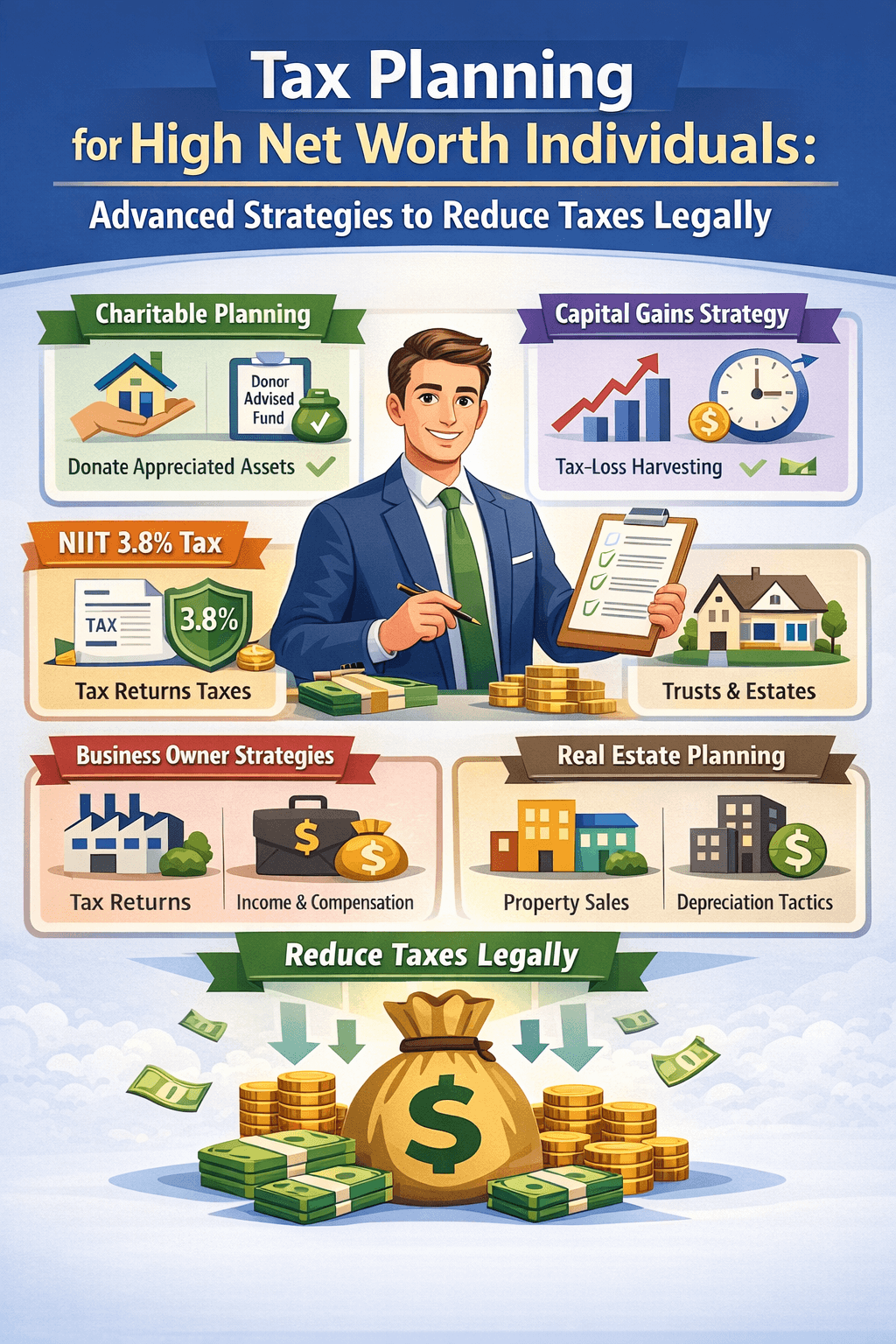
Tax Planning for High Net Worth Individuals
Advanced tax planning strategies for high net worth individuals
1) Coordinate capital gains with charitable planning
If you regularly donate, consider planning gifts in ways that can reduce taxes while meeting giving goals, such as:
- Donating appreciated assets (when appropriate)
- Bunching charitable contributions into high-income years
- Building a multi-year giving plan around liquidity events
This is often one of the cleanest “win-win” areas because it aligns tax strategy with philanthropy.
2) Use tax-loss harvesting as an ongoing system (not a one-time move)
Tax-loss harvesting is most effective when it’s built into a repeatable process:
- Identify loss positions throughout the year (not only in December)
- Offset current-year gains intentionally
- Coordinate with rebalancing so your portfolio stays aligned with your plan
For HNW families with large taxable accounts, consistency matters more than a single year-end scramble.
3) Plan around NIIT (3.8%) and the income thresholds
If your income is consistently above NIIT thresholds, advanced planning looks at:
- Which income sources count as net investment income
- Whether certain activities are treated as passive vs non-passive (when relevant)
- Timing gains and income events across tax years
NIIT is frequently overlooked in planning, yet it can materially increase the effective rate on investment income. (irs.gov)
4) Concentrated stock strategy (when a single position dominates)
Concentrated positions can create:
- Overexposure risk, and
- A large embedded tax bill if sold all at once
Common planning conversations include:
- Multi-year sell plans to manage brackets and surtaxes
- Charitable strategies (if giving is part of your goals)
- Hedging and risk management (requires careful advice and suitability review)
5) Real estate planning (depreciation, passive rules, disposition timing)
Real estate-heavy HNW plans often focus on:
- Timing of property sales and gain recognition
- Structuring ownership for reporting clarity
- Coordinating depreciation and improvements with a bigger multi-year plan
This area gets technical quickly, so the best results come from clean bookkeeping, strong documentation, and proactive projections.
6) Business owner strategies (pass-through planning, compensation, entity choices)
For business owners, high-impact planning can involve:
- Reviewing entity structure and tax treatment
- Compensation strategy and benefits planning (where applicable)
- Timing of income recognition and large purchases
- State tax strategy (especially if you operate in multiple states)
This is where a tax plan becomes more than a tax return—it becomes part of operating strategy.
7) Estate + gifting strategy (use annual exclusions and lifetime planning intentionally)
If estate planning is relevant, advanced tax planning commonly includes:
- A gifting plan that uses annual exclusions efficiently ($19,000 per recipient for 2026) (irs.gov)
- Reviewing your projected estate size against the 2026 exclusion amount ($15,000,000 per person) (irs.gov)
- Trust planning conversations (types and fit depend on goals, risk tolerance, family situation, and state law)
Even if you won’t owe estate tax, gifting and trust planning can still matter for control, privacy, and family governance.
The planning cadence that works best (simple framework)
Monthly
- Update year-to-date income and realized gains/losses
- Track major deductions and charitable giving
- Review big upcoming events (bonuses, vesting, sales, distributions)
Quarterly
- Refresh projections (income, gains, estimated payments)
- Decide whether to accelerate/deferral certain actions
- Confirm documentation is clean
Q4 (October–December)
- Finalize year-end gains/losses
- Complete planned charitable moves
- Confirm business and estate planning actions that must happen before year-end
Common mistakes HNW individuals make
- Planning only in March/April (when it’s mostly too late to change outcomes)
- Ignoring NIIT and surtaxes until after the fact (irs.gov)
- Selling concentrated positions without a multi-year plan
- Mixing investment, business, and estate planning into separate “silos” that don’t talk to each other
- Poor documentation (which turns deductions into questions later)
Get a confidential high net worth tax planning review
If you want a smarter plan than “file and hope,” book a confidential tax planning review with a strategist who can coordinate your investment income, capital gains timing, charitable plan, business ownership strategy, and estate planning goals into one roadmap.
Bring:
- Last 2 years of returns
- Current-year income and realized gain summary
- A quick list of major assets and upcoming events (sale, vesting, property sale, business changes)
Educational content only—this is not individualized tax, legal, or investment advice. High net worth planning depends on your exact income sources, state rules, portfolio, and goals.