Tax Planning for Childcare Owners: How to Pay Less (Legally) and Keep More Cash in Your Business


Tax planning for childcare owners is not the same thing as “getting your taxes done.” It’s the year-round strategy that helps you control your tax bill, protect cash flow, and avoid the common mistakes that cause prove-it-later stress.
Childcare businesses have unique financial patterns—tuition timing, subsidy reimbursements, CACFP, staffing ratios, licensing costs, classroom materials, and constant payroll decisions. When your numbers aren’t organized around those realities, you can easily miss deductions, misjudge quarterly taxes, and overpay.
This guide breaks down how tax planning works for daycare and childcare businesses, the most common tax leaks, and what to do next if you want a predictable, optimized outcome.
Why tax planning matters more in childcare than most industries
Many childcare owners overpay because typical tax prep is reactive. A preparer can file a return based on what happened—but without a plan, you miss opportunities that have to be done before year-end.
Here’s what makes childcare different:
- Multiple revenue types (private pay, subsidies, grants, registration fees)
- CACFP reimbursements and food-related tracking
- Payroll as the biggest expense (and biggest compliance risk)
- Enrollment seasonality (summer vs school year shifts)
- Licensing, training, inspections, background checks
- Classroom materials, curriculum, and facility maintenance
Tax planning connects all of that into a strategy, so the business keeps more of what it earns.
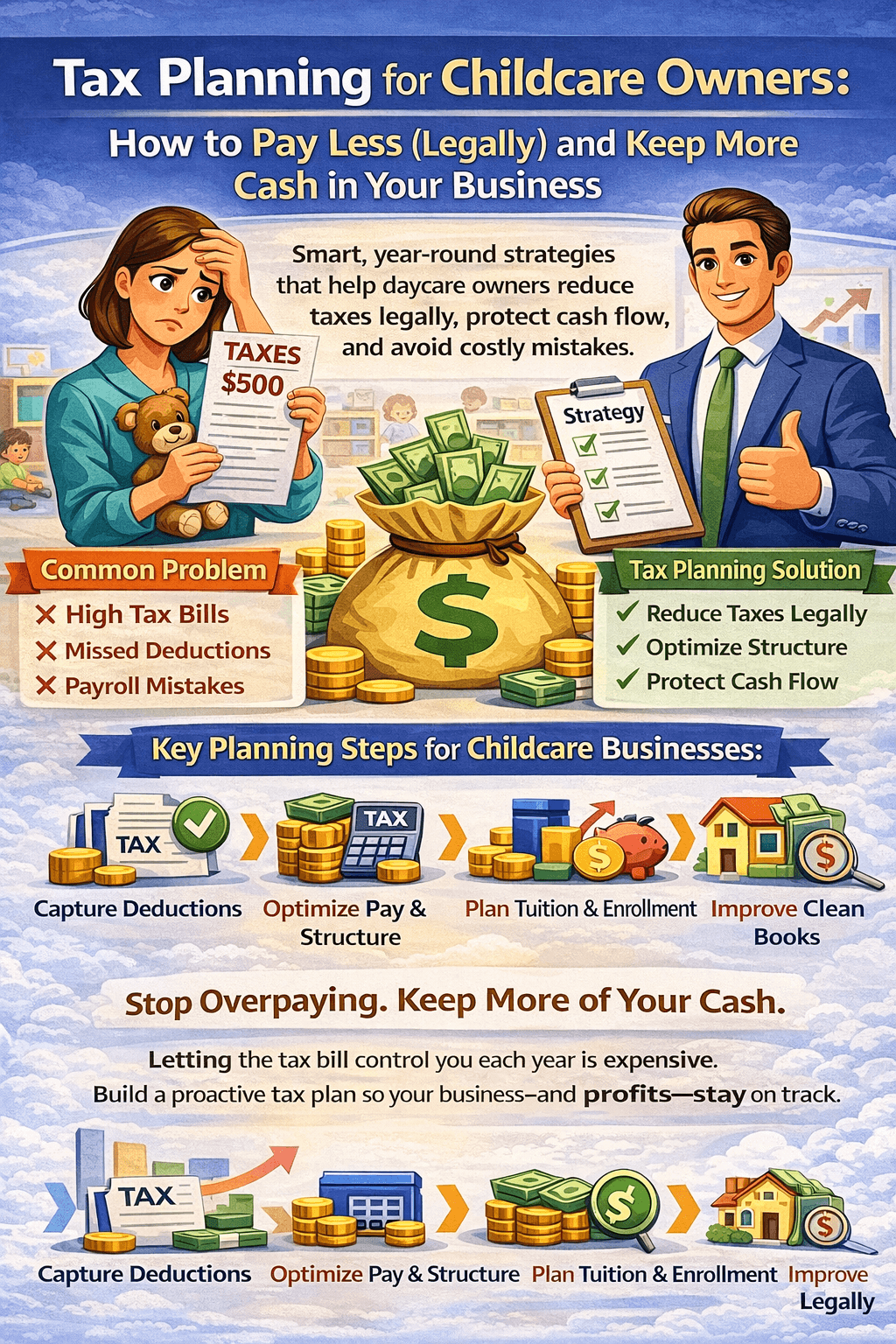
Tax Planning for Childcare Owners
What “tax planning for childcare owners” really means
Tax planning is a system to:
- Forecast your tax liability throughout the year
- Capture childcare-specific deductions correctly
- Set up payroll and owner pay strategically
- Choose the right structure for your profit level
- Pay the right amount in quarterly estimates (not too little, not too much)
- Make smart year-end moves with clear documentation
In simple terms: you plan the outcome, instead of accepting the outcome.
The most common reasons childcare owners overpay taxes
1) Books that are “done” but not tax-ready
If your bookkeeping categories are vague or inconsistent, you lose deductions and can’t forecast accurately. Common problems include:
- “Misc” categories swallowing real deductions
- Mixed personal and business spending
- Tuition, subsidies, and other income not separated
- Reconciliations not done monthly
2) Missing childcare-specific deductions
The issue is rarely “you don’t have expenses.” The issue is expenses not being tracked in a way that makes them easy to claim and defend.
Common childcare deduction areas include:
- Licensing, inspections, and compliance costs
- Background checks and required training (CPR/first aid, certifications)
- Classroom supplies, curriculum, toys, learning materials
- Cleaning, sanitizing supplies, and safety upgrades
- Childcare software, admin tools, phones, internet
- Insurance (liability, workers comp, business coverage)
- Marketing (website, ads, local promotions, signage)
- Facility costs (rent, utilities, maintenance, repairs)
3) Quarterly taxes guessed instead of planned
Many childcare owners either:
- Don’t pay quarterly estimates and get penalties, or
- Overpay quarterly because they’re afraid of the IRS
Tax planning gives you a projection based on real numbers, so payments are accurate and cash flow stays healthier.
4) Payroll mistakes (a major tax and audit risk)
Payroll in childcare is complex, and mistakes can be expensive. Examples:
- Misclassification of staff
- Payroll taxes not handled consistently
- Wage and benefit reporting confusion
- Poor tracking of payroll burden when staffing changes
A tax plan reviews payroll strategy because payroll choices directly affect profit and taxes.
A practical childcare tax planning framework (simple and effective)
Step 1: Get clean, reliable monthly numbers
Tax planning starts with accurate books:
- Bank and credit cards reconciled every month
- Income separated by type (tuition vs subsidy vs other)
- Payroll properly mapped
- Childcare-appropriate chart of accounts
If your books are behind, the best plan is to catch up quickly enough to create a reliable baseline.
Step 2: Build a tax forecast (so you can see where you’re headed)
A forecast helps you answer:
- What will I owe if nothing changes?
- What happens if enrollment rises or payroll grows?
- How much should I set aside monthly?
- Are quarterly payments on track?
This is the core of proactive tax planning.
Step 3: Align structure and owner pay with your profit level
As your childcare business grows, the “default” setup can become expensive. Tax planning evaluates whether your current structure and compensation method still makes sense for your numbers.
This is one of the areas where childcare owners can see major differences—especially when profit is strong and consistent.
Step 4: Use year-end planning to lock in savings
By Q4, you should know:
- Your projected taxable profit
- What actions could reduce the tax bill legally
- What documentation is needed
- Which purchases or upgrades should be timed intentionally
Planning in October–December is often where the biggest wins happen, because you still have time to act.
Tax planning tips for high-revenue or multi-location childcare owners
If you’re running a larger childcare operation, tax planning should include reporting that supports decision-making at scale:
- Profit by location
- Profit by classroom / age group
- Payroll burden tracking
- Cash flow forecasting for expansion
- Budget planning tied to enrollment and staffing
At this level, tax planning overlaps with CFO-style planning, because better decisions create better tax outcomes.
FAQs: tax planning for childcare owners
How often should childcare owners do tax planning?
A strong minimum is quarterly (aligned with estimated taxes). Many established centers benefit from a monthly review plus quarterly strategy.
Is tax planning the same as tax preparation?
No. Tax preparation reports what happened. Tax planning helps you shape what happens so the final result is better.
What if I’m behind on bookkeeping or taxes?
You can still plan, but the first priority is getting accurate numbers so the strategy is based on reality, not guesses.
CTA: Get a Childcare Tax Plan Built Around Your Numbers
If you’re a childcare owner and you suspect you’re overpaying—or you want a clear plan that makes your tax bill predictable—book a Tax Planning Assessment with Daycare AccountingPRO.
You’ll get a strategy tailored to how childcare revenue and payroll actually work, plus clear next steps to reduce taxes legally and improve cash flow.
(Educational content only. Real tax planning requires reviewing your specific financials and structure.)