Advanced Tax Planning for Childcare Owners: High-Impact Strategies to Reduce Taxes and Improve Cash Flow


Advanced tax planning isn’t about finding one “magic deduction.” It’s about building a repeatable system that helps childcare owners control their tax outcome before the year ends—especially when revenue is growing, payroll is rising, or you’re adding a second (or third) location.
If you’re doing $500K–$5M+ in annual revenue, running multiple classrooms, managing staff turnover, and dealing with tuition timing, subsidies, CACFP, and expansion costs, basic tax prep is not enough. You need a plan that connects your books, payroll, structure, and cash flow into one strategy.
What counts as “advanced tax planning” in childcare?
Advanced tax planning means you’re not just tracking expenses—you’re actively managing:
- Taxable profit (not just bank balance)
- Entity structure and owner pay
- Payroll strategy and compliance
- Timing of income, purchases, and capital improvements
- Multi-location reporting and forecasting
- Documentation that supports deductions confidently
It’s the difference between “hoping the tax bill is reasonable” and knowing—quarter by quarter—where you’re headed.
Who needs advanced tax planning?
Advanced planning is usually a fit when at least one is true:
- Your childcare business is consistently profitable and growing
- You’re paying a large tax bill every year and don’t know why
- You’re opening a new center, adding classrooms, or signing a new lease
- You have multiple revenue streams (private pay + subsidy + grants)
- Payroll is your biggest expense and feels hard to control
- You want cleaner, location-based reporting to guide decisions
If you’re already paying “real money” in taxes, the upside from advanced planning can be significant.
Advanced strategy #1: Build a quarterly tax forecast tied to real childcare drivers
Most owners only look at profit after the year ends. Advanced planning starts with a quarterly forecast that updates when these change:
- Enrollment and capacity by classroom
- Tuition price changes and discounts
- Subsidy timing and reimbursement schedules
- Payroll (including overtime, bonuses, and staffing shifts)
- Major purchases and facility improvements
- Expansion costs (buildouts, deposits, licensing, recruiting ramp)
When you forecast quarterly, you can adjust decisions early—so you don’t get trapped by a surprise tax bill.
Advanced strategy #2: Optimize your chart of accounts for childcare-specific deductions
This is one of the fastest ways to stop losing money.
Many childcare businesses overpay because expenses are buried in categories like “misc,” “supplies,” or “repairs.” Advanced planning means your bookkeeping is designed to produce tax-ready reporting and clear documentation.
A childcare-optimized chart of accounts typically separates things like:
- Classroom supplies vs curriculum vs learning materials
- Food program costs and meal-related expenses (CACFP support)
- Licensing, compliance, inspections, and required training
- Recruiting, onboarding, staff development, and retention
- Facility repairs vs improvements (important distinction)
- Parent communication tools, childcare software, and admin systems
Clean categories make deductions easier to defend and easier to plan around.
Advanced strategy #3: Owner pay strategy (where big savings often live)
If your business structure and owner pay are not aligned with your profit level, you can end up paying more than necessary.
Advanced planning reviews how owner compensation is handled, such as:
- Whether payroll is set up in a way that matches your goals
- How owner pay affects payroll taxes vs pass-through income
- Whether reimbursements and accountable plans are being handled properly (when applicable)
- Whether benefits or expense policies are documented and consistent
This is not a “one-size-fits-all” decision. The best approach depends on your profit, growth plans, and compliance tolerance.
Advanced strategy #4: Multi-location reporting and “profit per classroom” analysis
If you run more than one location—or you’re planning to—advanced planning should include location-based reporting, so you can see:
- Profit by site
- Profit by classroom / age group
- True payroll burden by team and schedule
- Rent + occupancy cost impact by location
- What’s driving margin changes month to month
Why this matters for taxes: when you know exactly where profit is being created, you can plan staffing, pricing, and growth decisions that raise margin without creating chaos.
Advanced strategy #5: Timing strategy for purchases, improvements, and buildouts
Childcare owners make large spending decisions: playground upgrades, security systems, flooring, classroom buildouts, office equipment, software, vans, signage, and more.
Advanced planning helps you decide:
- Whether a cost is more likely an expense vs a capital improvement
- The best timing during the year (based on projected profit)
- How to document purchases cleanly
- How to plan around cash flow so you don’t “save on taxes” but run out of cash
This strategy is especially important when you’re expanding or renovating.
Advanced strategy #6: Payroll tax risk management (because childcare payroll is complex)
Payroll is often your largest expense—and one of the easiest places to create tax risk.
Advanced planning should include periodic checks for:
- Employee vs contractor classification issues
- Payroll tax deposits and filing accuracy
- Benefit and reimbursement handling
- Bonus timing and payroll burden forecasting
- State-specific requirements (where applicable)
Even if you’re using a payroll provider, the strategy still matters—because payroll choices can change both your cash flow and your tax bill.
Advanced strategy #7: Documentation systems that protect deductions (and reduce stress)
Advanced planning isn’t only about math. It’s also about being ready if questions come up.
Strong documentation systems usually include:
- Clear policies for reimbursements and business spending
- Digital storage for receipts and major contracts
- Consistent categorization rules (so the books stay stable)
- Notes for unusual items (grants, subsidies, one-time expenses)
- Clean separation of business and personal transactions
When documentation is tight, you can claim deductions confidently and spend less time “rebuilding history” at tax time.
Advanced strategy #8: Strategic planning for expansion (without tax surprises)
Opening a new center is exciting—but it can create tax and cash-flow problems if you don’t plan ahead.
Advanced expansion planning includes:
- Forecasting ramp-up months (low enrollment + high payroll)
- Planning deposits, buildout costs, and licensing expenses
- Setting expectations for the first 6–12 months of tax liability
- Designing reporting so the new site is trackable from day one
This is where advanced tax planning overlaps with CFO-style planning: you need visibility, not guesswork.
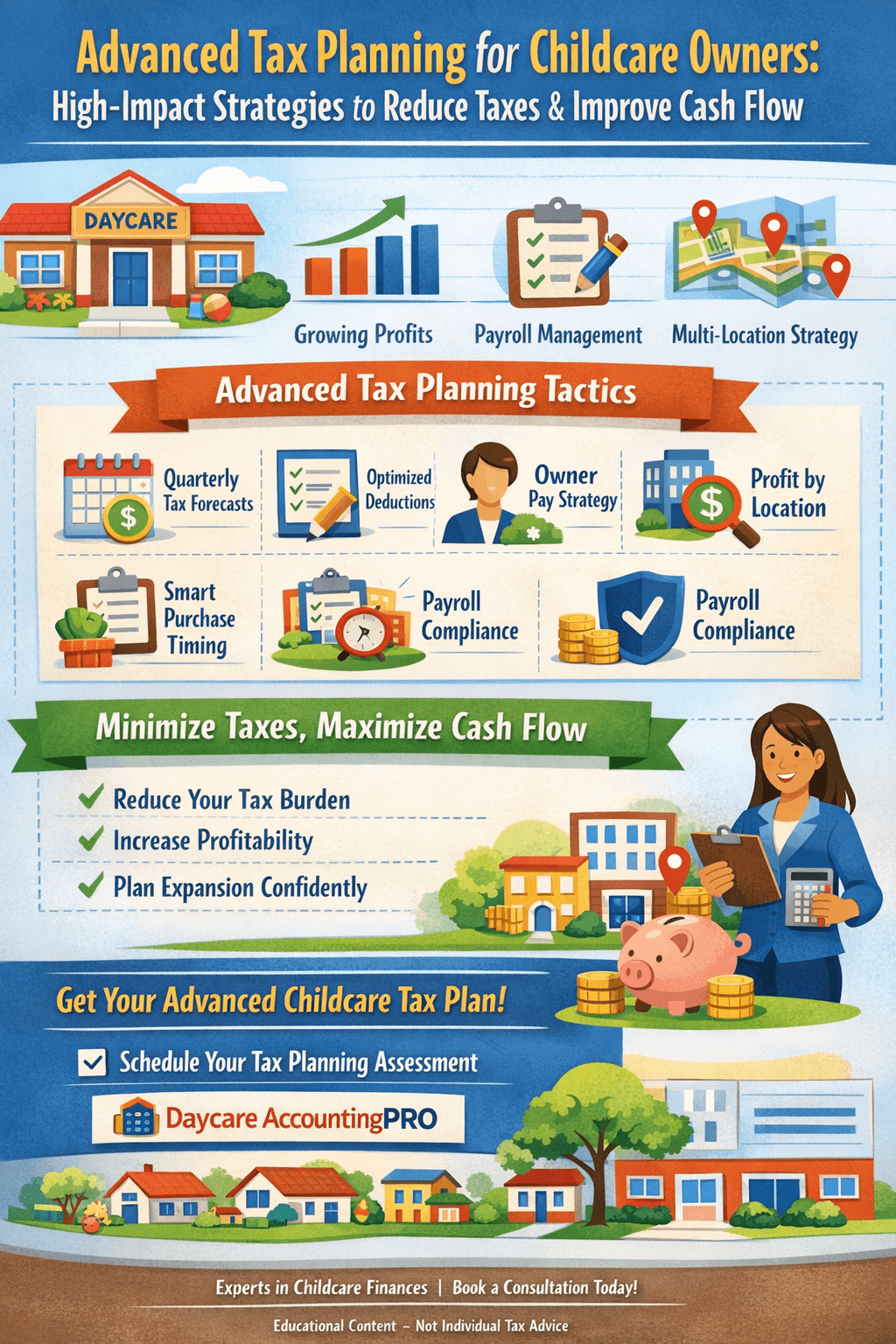
Advanced Tax Planning for Childcare Owners
What advanced tax planning looks like in practice (a simple framework)
Here’s a practical way to run it:
Monthly (15–30 minutes with the right reports)
- Review profit and cash movement
- Confirm payroll and big expenses
- Check your “year-to-date tax forecast” trend
Quarterly
- Update tax projections
- Adjust estimated payments if needed
- Decide on any year-end moves early (purchases, payroll changes, policy updates)
Year-end (Q4)
- Finalize tax plan actions
- Confirm documentation
- Lock in decisions that affect taxable profit
The goal is a calm tax season because you already know the outcome.
CTA: Get an Advanced Childcare Tax Plan Built Around Your Numbers
If you’re ready for advanced tax planning—especially if you’re multi-center, scaling fast, or paying a large tax bill every year—book a Tax Planning Assessment with Daycare AccountingPRO.
We’ll review your current setup, identify the highest-impact opportunities, and build a strategy tied to your enrollment, payroll, and expansion plans—so your tax outcome becomes predictable and optimized.
(This content is educational and not individualized tax advice. A real plan requires reviewing your specific numbers and business structure.)